How to Get a T-money Card in Korea (and Top It Up)
Quick answer
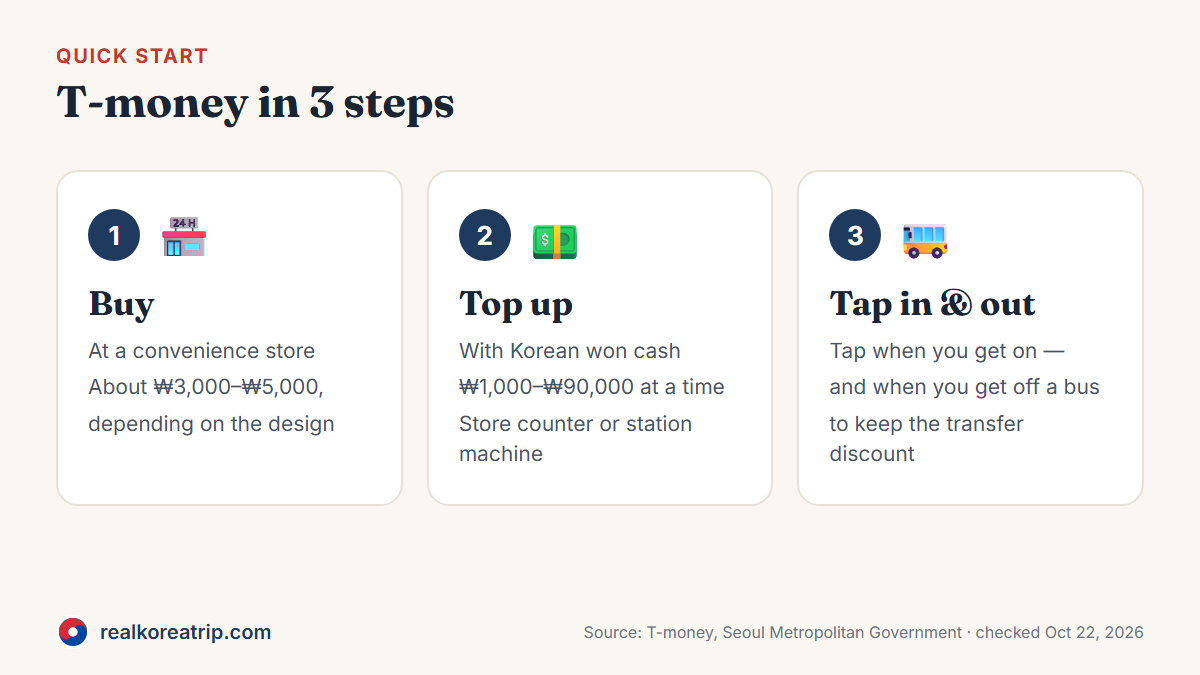
- Buy a T-money card at a convenience store (GS25, CU, 7-Eleven, emart24 and others). Cards cost about ₩3,000–₩5,000 depending on the design — top it up before your first ride.
- Top it up with Korean won cash at the store counter or at subway station top-up machines.
- Tap your card when you get on and when you get off the bus, or you lose the transfer discount.
- Climate Card short-term passes no longer cover several Gyeonggi Province sections (including Gimpo, Goyang and Seongnam).
- 440 new ticket machines at 273 stations on Seoul Subway Lines 1–8 now sell single-journey tickets and Climate Card short-term passes to overseas Visa and Mastercard holders (about 3.7% card fee).
What is T-money?
T-money is Korea's rechargeable transit card. You load money onto it, tap it on the reader, and the fare comes off the balance. It also works outside Seoul — Busan's subway and buses accept it, for example — and on taxis. Transfer rules differ from city to city.
You don't have to use one: you can buy single-journey subway tickets at station machines — with cash, or with an overseas Visa or Mastercard at the newer machines on Lines 1–8 (about 3.7% card fee). But a card is cheaper on the subway, and you need one to get the transfer discount between buses and the subway.
| Seoul fare (adult, as of Oct 2026) | With T-money | Single ticket / cash |
|---|---|---|
| Subway, first 10 km | ₩1,550 | ₩1,650 |
| City bus — trunk (blue) or branch (green) | ₩1,500 | ₩1,500 |
Smaller green local (village) buses cost ₩1,200, and red rapid buses ₩3,000.
Source: Seoul Metropolitan Government — subway fares (in effect since June 28, 2025) and bus fares; checked Oct 22, 2026.
Paying a bus fare in cash is getting harder: Seoul listed 183 cash-free bus routes as of January 2026, so plan to pay buses with a card.
Source: Seoul — cash-free bus routes (Korean), checked Oct 22, 2026.
Where to buy a T-money card
The surest place is a convenience store. T-money lists GS25, CU, 7-Eleven, emart24, MINISTOP, Story Way and 365PLUS as sellers. Ask at the counter for a "T-money card".
- Price: about ₩3,000–₩5,000, depending on the design. Basic cards are ₩3,000 when the store has them.
- The price is for the card only. Top it up before your first ride.
- The card price isn't included in balance refunds — you only get back the money loaded on it.
Source: T-money — card types and prices, T-money guide for foreign visitors and Korea Tourism Organization; checked Oct 22, 2026.
The Korea Tourism Organization says information centers in Seoul subway stations on Lines 1–8 also sell cards, but T-money's own guide for visitors lists subway stations as top-up points only. A convenience store is the surest bet.
How to top it up
Top-ups at convenience stores and subway station machines are made with Korean won cash. You can top up:
- at any convenience store counter that sells T-money — hand over the card and the cash, and say how much you want to add
- at the top-up machines and information centers in subway stations
The rules:
- ₩1,000 to ₩90,000 per top-up, in ₩1,000 steps
- A card can hold up to ₩500,000
Source: T-money guide for foreign visitors, checked Oct 22, 2026.
How transfers work (and how to save money)
In Seoul, when you switch between the subway and a bus, or between two buses, the trip is charged as one journey instead of a new base fare for each ride (extra distance charges can still apply). To get it:
- Tap the card when you get on and when you get off the bus. In Seoul, tapping off is required for the transfer discount.
- Make the transfer within 30 minutes of getting off — or within 60 minutes between 9 pm and 7 am.
- Re-boarding the same bus route doesn't count as a transfer.
- One trip can include up to four transfers (five rides).
Source: Seoul Metropolitan Government, checked Oct 22, 2026.
Mistakes to avoid
- Not tapping off the bus. Your next ride is then charged as a new trip instead of a discounted transfer.
- Tapping your whole wallet. With several contactless cards together, the reader may not read the right one. Take the T-money card out and tap it on its own.
- Loading too much at the end of your trip. Some refund points charge a fee, and larger balances are hard for visitors to refund (see below).
Getting your money back before you fly home
You can cash out the money left on the card:
| Where | What you can refund | Fee |
|---|---|---|
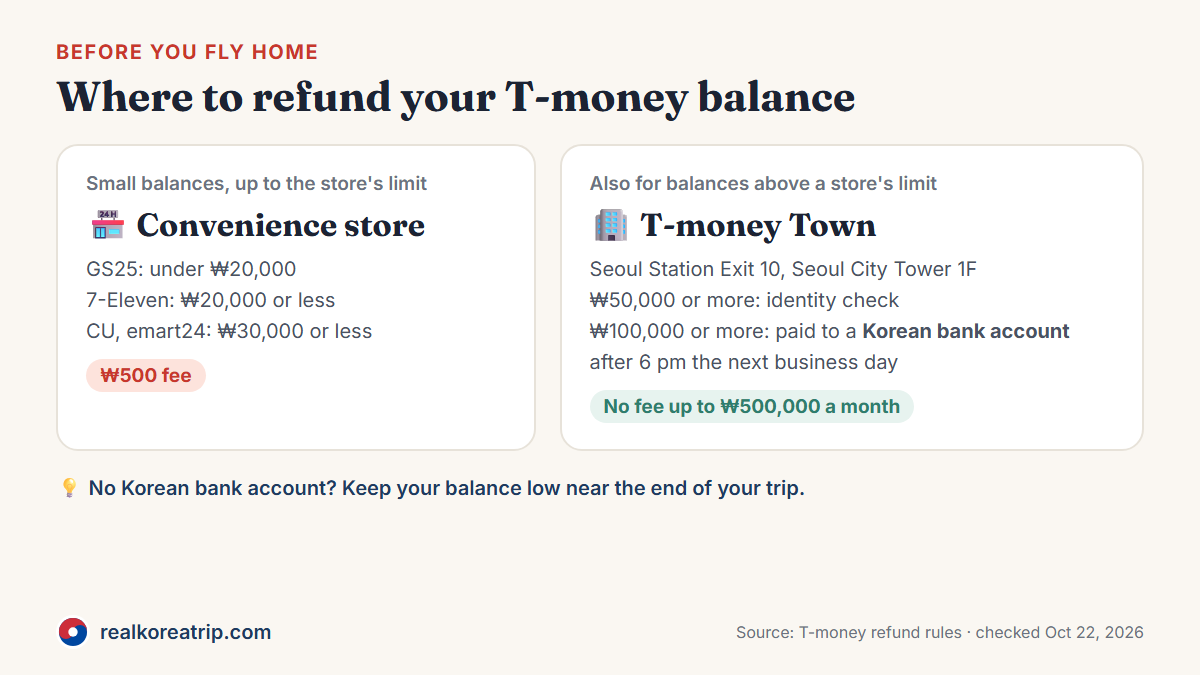
| A convenience store that sells T-money | Balances up to the store's limit: GS25 under ₩20,000 · 7-Eleven ₩20,000 or less · CU and emart24 ₩30,000 or less | ₩500 |
| T-money Town (Seoul Station Exit 10, Seoul City Tower 1F) | Also balances above a store's limit — including amounts of ₩50,000 or less | No fee for refunds up to ₩500,000 a month in total; 1% above that |
At T-money Town:
- Refunds of ₩50,000 or more require an identity check (name, date of birth and contact details).
- Refunds of ₩100,000 or more are paid into a Korean bank account after 6 pm on the next business day (not weekends or public holidays). Bring ID and a copy of your bankbook for this.
Bank ATM refunds also exist, but they need a Korean bank account in your own name. Check the official refund rules before you go.
If you don't have a Korean bank account, keep your balance low near the end of your trip.
Source: T-money refund rules (Korean), checked Oct 22, 2026.
Using T-money outside Seoul
T-money also works outside Seoul. In Busan, it's accepted on the subway and buses, and bus–subway transfers within 30 minutes are discounted. Seoul's transfer rules don't automatically apply elsewhere — check the local rules. Busan's subway fare with a card is ₩1,600–₩1,800 depending on distance (as listed by Busan Transportation Corporation).
Source: Busan Transportation Corporation, checked Oct 22, 2026.
Paying for taxis
Taxis in Korea generally accept cash, credit cards and transit cards such as T-money.
Source: Korea Tourism Organization — Taxis, checked Oct 22, 2026.
T-money or a Climate Card pass?
If you'll spend most of your trip in Seoul, Seoul's Climate Card short-term pass is the main alternative. It gives unlimited rides for a set number of days:
| Pass | Price |
|---|---|
| 1 day | ₩5,000 |
| 2 days | ₩8,000 |
| 3 days | ₩10,000 |
| 5 days | ₩15,000 |
| 7 days | ₩20,000 |
Source: Seoul Metropolitan Government — Climate Card, checked Oct 22, 2026.
The physical card costs ₩3,000 extra. The pass starts on the day you load it, and a 1-day pass lasts until that day's last bus or subway — not 24 hours. You can pay for these passes with an overseas Visa or Mastercard — since March 17, 2026 also at 440 new ticket machines on Seoul Subway Lines 1–8 (about 3.7% card fee).
What it doesn't cover: the Sinbundang Line, subway lines outside Seoul, buses not licensed by Seoul, airport and intercity buses, and taxis. At Incheon Airport you can only get off with it — you can't board the AREX train there. Coverage changed on October 1, 2026 — several Gyeonggi Province sections were removed — so check the official FAQ (Korean) before you buy.
FAQ
Can I use T-money outside Seoul?
Yes — for example, Busan's subway and buses accept it. Note that the AREX Express airport train needs a separate ticket.
Can I top up T-money with a credit card?
Not for regular T-money top-ups at convenience stores and subway stations — those are made with Korean won cash. Climate Card passes and single-journey subway tickets can be bought with an overseas Visa or Mastercard at the newer machines on Seoul Subway Lines 1–8.
Can I get the ₩3,000 card price back?
No. Refunds cover only the money left on the card. Convenience stores charge ₩500; T-money Town lists no fee for refunds up to ₩500,000 a month in total (1% above that).
Need help in English?
Call the 1330 Korea Travel Helpline (+82-2-1330 from a foreign phone) for help in English and several other languages.
- T-money — Guide for foreign visitors (where to buy, top-up, transfers, refunds)
- T-money — Card types and prices
- T-money — Refund rules (Korean)
- Seoul Metropolitan Government — Subway fares and transfers
- Seoul Metropolitan Government — Bus fares and transfers
- Seoul Metropolitan Government — Climate Card
- Seoul Climate Card FAQ, short-term passes (Korean, updated Oct 2026)
- Korea Tourism Organization — Transportation cards
- Korea Tourism Organization — Taxis
- Busan Transportation Corporation — Fares
- Busan Transportation Corporation — Transfers
- Seoul Metropolitan Government — International cards for passes and single tickets (Mar 2026)
- Seoul — Cash-free bus routes (Korean, as of Jan 2026)
- Airport Limousine — FAQ on paying by transit card (Korean)
Last checked Oct 22, 2026. Details can change — please confirm with the official source before you travel.