Temple Stay in Korea: Types, Prices, Booking and What a Night Is Like
Quick answer
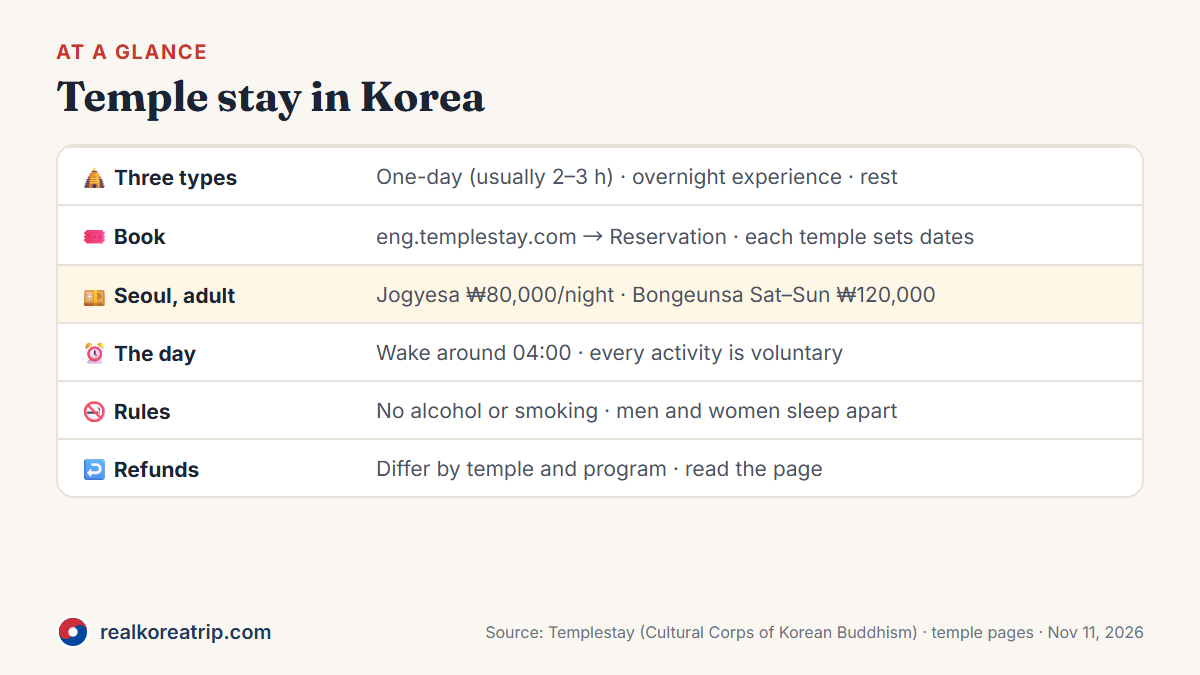
- Three types: a one-day program (usually 2–3 hours), an experience-oriented overnight (usually a weekend) and a rest-oriented stay with free time. You book on the official site, eng.templestay.com.
- Price examples (adult, Nov 11, 2026): in Seoul, Jogyesa's overnight is ₩80,000 a night and its daily program ₩10,000; Bongeunsa's Saturday–Sunday stay is ₩120,000. Prices are set by each temple and program.
- Before you book: wake-up is around 04:00, men and women sleep in separate rooms, alcohol and smoking are banned, and refund rules differ by temple. Many programs are listed through late December 2026; a few run longer.
A temple stay is a program run by Korean Buddhist temples where you join a slice of temple life, from a 2–3 hour visit to one or more nights, booked through the official site, eng.templestay.com. Each temple sets its own program and price: in Seoul on Nov 11, 2026, adult examples ran from ₩5,000 for Bongeunsa's Tuesday BONG-PASS to ₩120,000 for its Saturday–Sunday stay.
Source: Templestay — What is Templestay, Bongeunsa BONG-PASS and Bongeunsa Regular Templestay; checked Nov 11, 2026.
The short version
| Type | How long | What you do |
|---|---|---|
| One-day | "Normally" about 2–3 hours | Temple tour, meditation, tea |
| Experience-oriented | "Typically" one night, on a weekend | Dawn ceremony, 108 prostrations, a monastic meal, meditation |
| Rest-oriented | One night or longer | Set ceremony and meal times; the rest is free time |
The Templestay site, run by the Cultural Corps of Korean Buddhism, describes these three types and says activities "may vary with the temples, the season, and the interests of the participants". You can usually stay longer than two nights; the FAQ says the maximum "varies by the temples but usually lasts ten days".
Source: Templestay — What is Templestay and FAQ; checked Nov 11, 2026.
Price examples
These are the listed prices on Nov 11, 2026, per person, in won. They're examples, not a price range for all temples, and each temple can change them.
In Seoul
| Temple | Program (type) | Adult | Teen / Child | Listed until |
|---|---|---|---|---|
| Jogyesa (Jongno) | Regular Templestay (overnight) | ₩80,000 per night | ₩80,000 | Dec 31, 2026 |
| Jogyesa | Always Templestay (one-day, 10:00–11:20) | ₩10,000 | ₩10,000 / ₩10,000 | Dec 31, 2026 |
| Geumsunsa (Jongno) | Relaxational Templestay (rest) | ₩80,000 per night | ₩70,000 / ₩60,000 | Jul 31, 2027 |
| Myogaksa (Jongno) | "Where is your mind?" (overnight) | ₩95,000 | ₩95,000 | Dec 31, 2026 |
| Myogaksa | One-day, 10:00–14:00 | ₩50,000 | ₩50,000 / ₩50,000 | Dec 31, 2026 |
| Bongeunsa (Gangnam) | Regular Templestay, Sat–Sun (overnight) | ₩120,000 | ₩120,000 | Dec 27, 2026 |
| Bongeunsa | BONG-PASS, Tuesdays 10:00–16:00 (one-day) | ₩5,000 | ₩5,000 / ₩5,000 | Dec 31, 2026 |
Outside Seoul
| Temple | Program (type) | Adult | Note |
|---|---|---|---|
| Haeinsa (Hapcheon) | Tripitaka Koreana Pilgrimage, Sat–Sun | ₩100,000 (4-bed room) to ₩130,000 (single room) | Price depends on the room; no preschool children |
| Golgulsa (Gyeongju) | Moving Seon – Seonmudo, 1 night | ₩120,000 | Preschool ₩60,000 |
| Beomeosa (Busan) | Experiential Templestay, weekends | ₩100,000 per night | Ages over 5; no single rooms |
For Bongeunsa's other programs and the temple itself, see our Gangnam guide.
Source: Templestay booking pages for Jogyesa, Geumsunsa, Myogaksa, Bongeunsa, Haeinsa, Golgulsa and Beomeosa; checked Nov 11, 2026.
Is there a discount for foreigners?
The September 2026 foreigners' offer cited here (₩30,000 a night, Sept 1–30) has ended, and the November 2026 ₩30,000 "Double Happiness" offer is for Korean nationals only; its Korean notice answers "Can foreigners join?" with "No." Check the site's current notices for other offers.
Source: Templestay — notices; checked Nov 11, 2026.
How to book
- Go to eng.templestay.com → Reservation › Reservations, then pick an area and a temple.
- Open a program and read its page: dates, price, schedule, what's provided and the refund rules are all there.
- Press Reservation and follow the sign-in or booking steps shown on the site. Its sign-in page offers Google and Facebook as well as a site account.
- Pay the way that temple's page says. Jogyesa asks you to pay by card online and says card payment isn't available on the spot. Geumsunsa, Myogaksa and Golgulsa list payment at the temple.
When to book: Bongeunsa and Myogaksa open bookings one month before the date. Each page also says when booking closes: from 1 day before (Bongeunsa) to 3 days before (Jogyesa). Some programs are cancelled if too few people sign up. Myogaksa, for example, cancels when there are no more than 5 participants 4 days before.
You don't need to print anything: the FAQ says every temple has its reservation list, and adds that some temples may not send a confirmation email. To cancel or change, contact the temple or email support@templestay.com.
Source: Templestay — Reservations, FAQ and the temple booking pages above; checked Nov 11, 2026.
Refunds differ by temple
| Temple | Full refund | After that |
|---|---|---|
| Bongeunsa (Sat–Sun stay) | 14 days before | 70% at 7 days before; none from 6 days before |
| Jogyesa | 7 days before | None from 1–6 days before |
| Myogaksa | 3 days before | 50% at 2 days; none from 1 day before |
| Haeinsa | Up to 3 days before | 80% up to 2 days; 70% up to 1 day; none on the day |
The pages give only these cut-off points; for dates in between, ask the temple. Even within one temple the rule can change by program: Bongeunsa's Sunday evening program refunds 75% a week before, not 70%. Check the program you're booking.
Source: the temple booking pages listed under Sources; checked Nov 11, 2026.
What a night is like
The Korean FAQ describes a typical overnight: you check in around 14:00–15:00, get a room, a temple tour and a short lesson in temple manners, and the next day starts with the dawn ceremony at about 04:00. Real timetables vary:
| Temple | Check-in | Dawn |
|---|---|---|
| Bongeunsa | 13:50 | Wake 04:00, ceremony 04:20 |
| Jogyesa | 13:30 | Wake 04:00 |
| Haeinsa | 13:30–14:30 | Leave for the main hall 03:10, ceremony 03:40 |
| Beomeosa | By 14:00 | Ceremony 04:30 (optional) |
Every page says the schedule may change. Common parts are Yebul, the ceremony that opens the temple day; 108 prostrations; tea with a monk; and a monastic meal. Balwoogongyang is the formal bowl meal that the site describes as "Equality, Cleanliness, and Thrift", though many timetables just say "monastic meal".
You don't have to do everything. The Korean FAQ says all activities are voluntary, and if 108 bows don't sit right with your beliefs, you can sit quietly instead. The English FAQ adds that if you're unwell or tired you can rest in your room.
Source: Templestay — 템플스테이란? (Korean), What is Templestay, FAQ and the temple booking pages; checked Nov 11, 2026.
Rules and what to bring
- Rooms: men and women sleep in separate rooms. Jogyesa separates couples even if they're family, except parents with minor children. Sharing a room with strangers is normal; some temples offer private rooms for an extra fee (Jogyesa, Haeinsa), and Beomeosa has no single rooms.
- No alcohol or smoking: Bongeunsa, Jogyesa, Haeinsa and Beomeosa all say so.
- Quiet: keep your voice down around the halls; Haeinsa asks for "noble silence". At meals, Bongeunsa asks you to eat silently and take only what you can finish.
- Provided: "Commonly most of the temples only provide soap, toothpaste, and temple uniform (vest and pants)." There are exceptions; Jogyesa's tea program gives a vest only.
- Bring: towel, toiletries, underwear, socks, a change of clothes and warm layers in winter. The site warns that mountain temples "can be much colder than you might expect". Socks are required in the halls at Bongeunsa, Myogaksa and Haeinsa, and some temples don't allow sleeveless tops or flip-flops.
- Children: usually welcome with an adult, but rules differ: Beomeosa takes ages over 5, and Haeinsa's weekend program takes no preschool children. Ask the temple.
Source: Templestay — What is Templestay, FAQ and the temple booking pages; checked Nov 11, 2026.
Will it be in English?
It depends on the program. Myogaksa's overnight says "Program in English or translated in English", and Jogyesa's daily program says it's prepared for foreigners. The FAQ names Beopjusa, Bulguksa, Magoksa and Haeinsa as offering English programs. Many other pages, including Bongeunsa's weekend stay, don't say which language the program runs in. An English booking page doesn't mean an English-led program, so email the temple if it matters to you.
Source: Templestay — FAQ, Myogaksa and Jogyesa Always Templestay; checked Nov 11, 2026.
The Templestay Information Center in Seoul
The center is on the 1st floor at 56 Ujeongguk-ro, Jongno-gu, across the street from Jogyesa. It's about a 5-minute walk from Jonggak Station (Line 1) Exit 2 or Anguk Station (Line 3) Exit 6. The operator lists 09:00–18:00 every day, closed on New Year's Day, Seollal and Chuseok. Visit Seoul gives 09:00–19:00 on weekdays, so check before you go late. Visit Seoul says entry is free.
Source: Templestay — Information Center, How to get there, Visit Seoul — Templestay Information Center; checked Nov 11, 2026.
For help in English, call the 1330 Korea Travel Hotline (+82-2-1330).
Before you go
- Book on eng.templestay.com; read the program page to the end, including the refund rules.
- Many examples here are listed through late December 2026, but Geumsunsa's program lists an operating period through July 31, 2027, and Haeinsa's through February 29, 2028. An operating period doesn't guarantee bookable dates: check each program's reservation calendar for your travel dates.
- Expect to be up around 04:00. Pack socks, a towel, toiletries and warm clothes.
- No alcohol, no smoking, separate rooms for men and women.
- If you need English, check the program page or email the temple.
FAQ
How much does a temple stay cost in Korea?
Each temple sets its own price. On Nov 11, 2026, adult examples in Seoul were ₩5,000 for Bongeunsa's Tuesday BONG-PASS, ₩10,000 for Jogyesa's daily program, ₩80,000 a night at Jogyesa and Geumsunsa, ₩95,000 at Myogaksa and ₩120,000 for Bongeunsa's Saturday–Sunday stay.
How do I book a temple stay?
On the official site, eng.templestay.com: Reservation › Reservations, pick an area and a temple, open a program and press Reservation, then follow the steps shown. The site's sign-in page offers Google and Facebook as well as a site account.
What time do you wake up at a temple stay?
Around 04:00 at Bongeunsa and Jogyesa. At Haeinsa, guests leave for the main hall at 03:10. Taking part is voluntary, and the FAQ says you can rest in your room if you're tired.
Can foreigners get the ₩30,000 temple stay deal?
Not in November 2026: that offer is for Korean nationals only. The foreigners' ₩30,000 offer cited here ran Sept 1–30, 2026, and has ended. Check the site's notices for other offers.
Do men and women share rooms at a temple stay?
No. Men and women sleep in separate rooms. Sharing a room with other guests of the same sex is normal, and some temples offer private rooms for an extra fee.
Is a temple stay in English?
Some programs are. Myogaksa's overnight is in English or translated, and the FAQ names Beopjusa, Bulguksa, Magoksa and Haeinsa. Many pages don't say, so ask the temple.
- Templestay (Cultural Corps of Korean Buddhism) — What is Templestay
- Templestay — 템플스테이란? (Korean)
- Templestay — FAQ
- Templestay — Reservations
- Templestay — Information Center
- Templestay — How to get there
- Templestay — Jogyesa Regular Templestay
- Templestay — Jogyesa Always Templestay
- Templestay — Bongeunsa Regular Templestay
- Templestay — Bongeunsa BONG-PASS
- Templestay — Geumsunsa Relaxational Templestay
- Templestay — Myogaksa "Where is your mind?"
- Templestay — Myogaksa one-day program
- Templestay — Haeinsa Tripitaka Koreana Pilgrimage
- Templestay — Golgulsa Moving Seon
- Templestay — Beomeosa Experiential Templestay
- Templestay — 2026 Special Templestay for Foreigners (notice)
- Visit Seoul — Templestay Information Center (edited Oct 29, 2026)
Last checked Nov 11, 2026. Details can change — please confirm with the official source before you travel.
We publish new guides regularly and update old ones when fares, rules or hours change. Follow our free RSS feed in any feed reader (such as Feedly or Inoreader), or check the latest guides on our homepage.