Bringing Medicine into Korea: Limits, Prescriptions and the Narcotics Permit
Quick answer
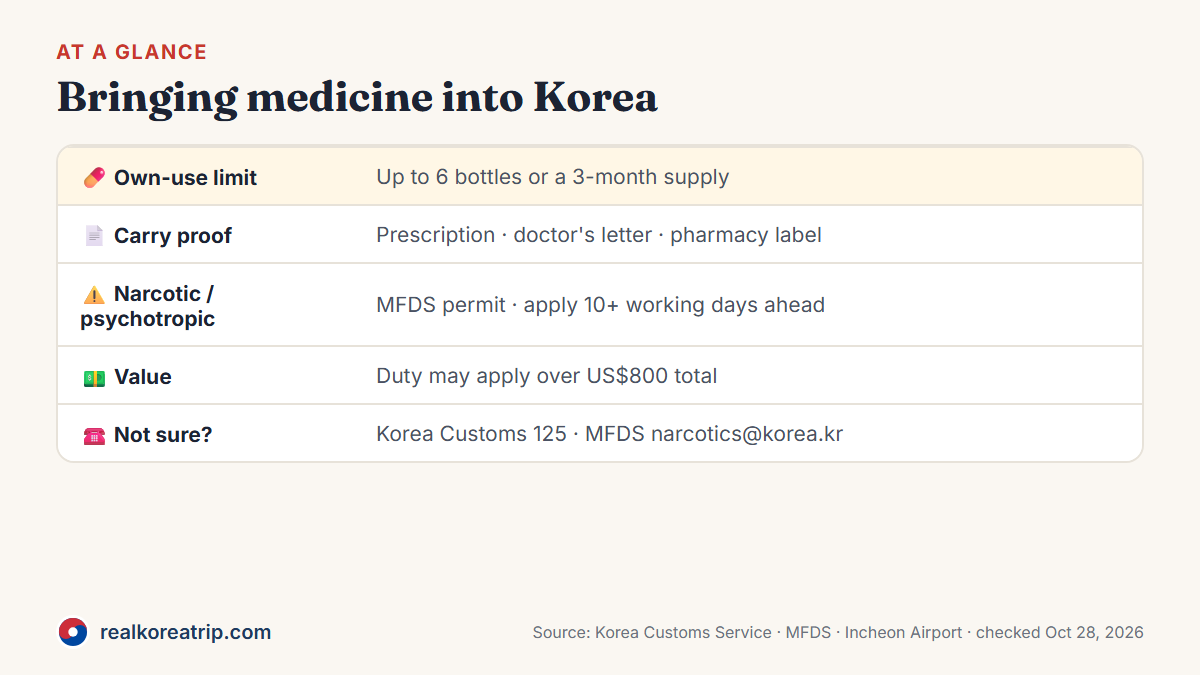
- Ordinary medicine for your own use: up to 6 bottles or a 3-month supply, per the Korea Customs Service. Carry proof it's yours — a prescription, a doctor's letter or the pharmacy label — and keep it in its original packaging.
- Medicines with narcotic or psychotropic ingredients (for example zolpidem, alprazolam, diazepam or Ritalin) need a permit from Korea's Ministry of Food and Drug Safety (MFDS) before you travel, whatever your nationality. You apply online; allow at least 10 working days.
- Not sure? Check by active ingredient, not brand name, and ask MFDS or Korea Customs (call 125) before you fly. Undeclared or unapproved medicines can be held at the airport.
You can bring ordinary medicine into Korea for your own use — up to 6 bottles or a 3-month supply, according to the Korea Customs Service — but medicines with narcotic or psychotropic ingredients need a permit from the Ministry of Food and Drug Safety (MFDS) before you arrive, whatever your nationality. Carry proof the medicine is yours: a prescription, a doctor's letter or the pharmacy label.
Source: Korea Customs Service guide via the Korean Embassy in Denmark (Aug 2023) and MFDS; checked Oct 28, 2026.
This guide covers medicine only. For the rest of your packing and the arrival forms, see the Korea first-timer checklist. It isn't medical or legal advice — the rules go by active ingredient, so check your own medicines with the agencies below.
The short version
| Your medicine | What the rules say | What to do |
|---|---|---|
| Ordinary medicine for yourself | Up to 6 bottles or a 3-month supply | Carry a prescription, doctor's letter or pharmacy label; keep the original packaging |
| Health supplements ("health functional foods") | Up to 6 bottles | Keep them in original containers |
| Narcotic or psychotropic medicine (e.g. zolpidem, alprazolam, diazepam, lorazepam, Ritalin) | Not allowed without an MFDS permit | Apply online to MFDS before you travel |
| Viagra or Cialis | Treated as medicines with misuse concerns | Customs clears only the quantity on a prescription from a Korean doctor |
| More than the limits — or restricted ingredients, unclear labels | Needs a separate import-requirement check | Ask Korea Customs before you fly |
Source: Korea Customs Service guide (Aug 2023); checked Oct 28, 2026.
1. Ordinary medicine: 6 bottles or 3 months
The Korea Customs Service guide says travelers can, in principle, bring medicine for personal use, up to 6 bottles or a 3-month supply. The Korean Embassy notice that shares the guide adds what to carry:
- Proof it's yours — a prescription, a medical certificate or the pharmacy label on the package.
- Proof you bought it lawfully — you may be asked for a receipt.
- The original packaging — recommended, so officers can see what it is.
Two things to watch:
- Value: duty can be charged if your goods total more than US$800, even within the 6-bottle or 3-month limit. US$800 is also the general duty-free allowance listed by Incheon Airport.
- The limit isn't the whole story. Korea Customs says medicine within the duty-free clearance scope is exempt from the separate import-requirement check, but medicine beyond that scope needs the check (a doctor's note listing the items can help for your own treatment). Some products need the check even within the limit: ones containing CITES-listed ingredients, products MFDS has banned or flagged as harmful, and packages without a clear ingredient label. If in doubt, ask Customs about your specific medicine.
Source: Korea Customs Service guide and embassy notice, Incheon Customs — medicines and health supplements (Korean) and Incheon Airport — customs; checked Oct 29, 2026.
2. Narcotic and psychotropic medicine: get the MFDS permit first
Since October 23, 2009, anyone entering Korea with medicine that contains a narcotic or psychotropic substance for their own treatment must get MFDS approval first — Korean or foreign, it doesn't matter.
The Customs guide names medicines that can't be brought in without following the legal procedure, including zolpidem, alprazolam, diazepam, lorazepam and Ritalin. "Narcotics, psychotropic drugs and related products" are also on Incheon Airport's list of prohibited items.
Source: MFDS notice, Korea Customs Service guide and Incheon Airport; checked Oct 28, 2026.
How to apply (online since December 27, 2024):
- Go to Drug Safety Korea (nedrug.mfds.go.kr/eng/index) and choose "Permit To Bring In Narcotics For Self-treatment."
- Verify your email and set a password — the site uses email login.
- Fill in your name, passport number, nationality, dates in Korea and flight number, then the medicine, its active ingredient and your dose.
- Attach your documents: a full-size copy of your passport and your flight reservation (plus proof of a long stay, if that applies). For the medical part, follow the form's options: normally a medical certificate or doctor's letter and a valid prescription. If your country's government issues an official export/import certificate for narcotic or psychotropic medicine, the manual says you can upload that instead of the medical letter and prescription.
- Submit and track the result in the same system.
Source: MFDS — online application user manual (English attachment); checked Oct 28, 2026.
Allow at least 10 working days. A Korean consulate's guide to the online permit says processing takes 10 working days, so you should apply at least 10 days before you arrive — and an application with missing documents, or one filed too late, may be returned. Apply earlier in case MFDS asks for more documents.
Source: Consulate General of Korea in Los Angeles — online permit guide (Korean, Jun 2025); checked Oct 29, 2026.
Questions go to the MFDS Narcotics Policy Division: +82-43-719-2813 or narcotics@korea.kr. The permit comes from MFDS, not from Korean embassies.
3. Viagra, Cialis and "health" products
The Customs guide lists Viagra and Cialis as medicines with a high risk of misuse. For these, customs clears only the quantity on a Korean doctor's prescription. It also warns that fake sexual enhancers are strictly controlled.
Traditional remedies need care too: products such as bear bile powder that aren't clearly labeled are refused entry under the Customs Act.
Source: Korea Customs Service guide; checked Oct 28, 2026.
4. If customs holds your medicine
- Held medicine is released only with confirming documents — the guide gives a prescription from a Korean doctor as the example.
- You can ask to have held items returned (sent back abroad), following customs' return procedure.
- The guide warns that held items can be discarded after one month. Ask the customs office holding your medicine which deadline applies to you.
Source: Korea Customs Service guide; checked Oct 28, 2026.
5. Declaring at the airport
If you have something to declare — for example medicine over the limits, or goods over US$800 — fill in the customs declaration form and use the "Goods to Declare" lane. Korea Customs says that if undeclared goods over the duty-free allowance are found, you pay an additional tax of 40% of the tax due. It rises to 60% if, counting back two years from your entry date, you have already been charged this surcharge at least twice — in effect, from the third time. Medicine-related violations can carry separate penalties, so ask Korea Customs about your case.
Source: Korea Customs Service — traveller declarations (Korean), the Enforcement Decree of the Customs Act, Article 247(4) (Korean) and Incheon Airport — customs; checked Oct 30, 2026.
Before you fly
- List your medicines by active ingredient, not brand name.
- Anything narcotic or psychotropic? Apply for the MFDS permit online — at least 10 working days before you arrive.
- Keep 6 bottles or 3 months' supply or less, in the original packaging.
- Pack the prescription or doctor's letter in your carry-on, with the medicine.
- Unsure? Ask Korea Customs (English Q&A, or call 125 in Korea, weekdays 09:00–18:00).
If you need a doctor or pharmacy while you're in Korea, see emergency help in Korea and pharmacies in Korea.
FAQ
How much medicine can I bring into Korea?
For ordinary medicine for your own use, up to 6 bottles or a 3-month supply, according to the Korea Customs Service. Duty can apply if your goods total more than US$800.
Do I need a prescription to bring medicine into Korea?
You need to show the medicine is for your own use — a prescription, medical certificate or pharmacy label works. Narcotic or psychotropic medicine also needs an MFDS permit before you travel.
Can I bring zolpidem (Ambien) or Xanax to Korea?
Zolpidem and alprazolam (the active ingredient in Xanax) are on the Customs guide's list of psychotropic drugs. You need an MFDS permit, applied for online before you travel.
Can I bring ADHD medication to Korea?
Ritalin is on the Customs guide's psychotropic list, so it needs an MFDS permit. For other ADHD medicines, check the active ingredient with MFDS before you fly.
Who do I ask if I'm not sure?
For narcotic or psychotropic medicine, the MFDS Narcotics Policy Division (+82-43-719-2813, narcotics@korea.kr). For everything else, Korea Customs (call 125 in Korea, or the English Q&A online).
- Korea Customs Service, Incheon — Traveler customs clearance (Korean)
- Korea Customs Service — Customs clearance of medications, health functional foods and psychotropic drugs (guide shared by the Korean Embassy in Denmark, Aug 2023)
- Ministry of Food and Drug Safety — Permit to bring in narcotics for self-treatment (online since Dec 27, 2024)
- Ministry of Food and Drug Safety — Drug Safety Korea, English site (permit application)
- Incheon International Airport — Customs: duty-free allowance and prohibited items
- Korea Customs Service — Traveller declarations and penalties (Korean)
- Korean Law Information Center — Enforcement Decree of the Customs Act, Article 247 (Korean)
- Korea Customs Service — English Q&A
- Incheon Customs — Medicines and health supplements for personal use (Korean)
- Consulate General of Korea in Los Angeles — Online permit for narcotic medicines (Korean, Jun 2025)
Last checked Oct 30, 2026. Details can change — please confirm with the official source before you travel.
We publish new guides regularly and update old ones when fares, rules or hours change. Follow our free RSS feed in any feed reader (such as Feedly or Inoreader), or check the latest guides on our homepage.