Tax Refund in Korea: How Visitors Get Money Back on Shopping
Quick answer
- Foreign visitors staying in Korea for less than 6 months can claim back VAT on goods bought at stores that show a Tax Refund sign, for purchases of ₩15,000 or more in a single transaction.
- Instant refunds at the till work for purchases under ₩1,000,000 each, up to ₩5,000,000 in total per trip — just show your passport.
- For other refunds, finish export clearance before you send your bags off: scan your passport at the airport refund kiosk, and if it asks for a customs inspection, show the unopened goods. No customs confirmation, no refund.
Prices in Korean shops include value-added tax, and as a visitor you can get part of it back. The rules aren't complicated, but the one step people miss, getting their purchases cleared for export at the airport before they check their bags, is the one that costs them the refund. Here's how it works, from the till to the departure gate.
The short version
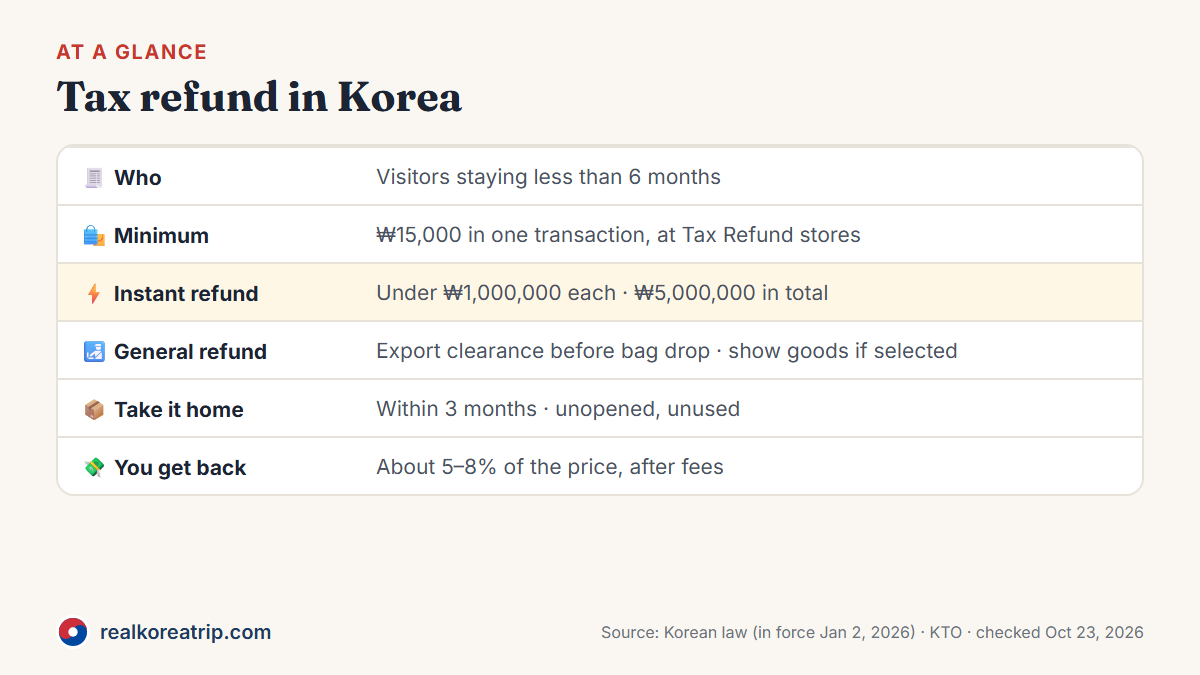
| What the rules say | |
|---|---|
| Who | Foreign visitors staying in Korea for less than 6 months (and some overseas Koreans) |
| Where | Stores showing a "Tax Refund" sign with a refund company's logo |
| Minimum | ₩15,000 in a single transaction |
| Instant refund in store | Under ₩1,000,000 per purchase, up to ₩5,000,000 in total after you arrive |
| Take it out of Korea | Within 3 months of buying |
| How much back | Roughly 5–8% of the price, after fees |
Source: Korea Tourism Organization — comprehensive tax refund guide and the Presidential Decree and enforcement rules in force from Jan 2, 2026 (Korean); checked Oct 23, 2026.
Who can claim
Foreign visitors staying in Korea for less than 6 months generally qualify, as do overseas Koreans who have lived abroad for at least 2 years and are staying in Korea for 3 months or less. You can't claim if you're staying 6 months or longer, work in Korea, or are a diplomat or US military personnel stationed in Korea. Purchases made under a company name or through someone else don't count either.
Source: Korea Tourism Organization — comprehensive tax refund guide; checked Oct 23, 2026.
What you can claim on
Most goods qualify: clothes, shoes, bags, cosmetics, perfume, electronics, ginseng. A few things don't. Cooked food and services such as massages are out, because customs can't inspect them when you leave. So are items you've opened or used before taking them out of Korea, anything bought duty-free, and goods that are banned anyway.
Two practical rules matter more than the list. First, only stores that offer tax refunds count, and they show a "Tax Refund" sign with the refund company's logo. Second, an ordinary receipt isn't enough: ask for the tax refund documents when you pay, and keep them until you leave.
Source: Korea Tourism Organization — comprehensive tax refund guide; checked Oct 23, 2026.
Instant refund: the easy way
At stores that offer it, you show your passport and pay the price with the tax already taken off. In the official guide, the steps for an instant refund end there: check eligibility with your passport, pay the lower price, then leave Korea as normal. The limits are set in law: each purchase must be under ₩1,000,000, and your instant-refund purchases since arriving can't exceed ₩5,000,000 in total. The store can deduct an approved processing fee from the tax amount.
Source: Korea Tourism Organization — comprehensive tax refund guide and the Presidential Decree (Korean); checked Oct 23, 2026.
General refund: pay now, claim later
Everything else works the other way round. You pay the full price, take the refund voucher, and claim the money later in one of four ways:
- Downtown: at a staffed refund center or an unmanned kiosk in the city, for single purchases of ₩6,000,000 or less. Bring your passport, the voucher and a credit card. You still have to get the customs check when you leave.
- At the airport: through the refund kiosk and, if needed, the customs check, then at a refund counter or kiosk.
- By mailbox: at ports without a refund counter, drop the customs-confirmed voucher in the mailbox, with your details and refund method written on it.
- By mobile: submit the customs-confirmed voucher through the refund company's app or website.
Source: Korea Tourism Organization — comprehensive tax refund guide; checked Oct 23, 2026.
At the airport: the order that matters
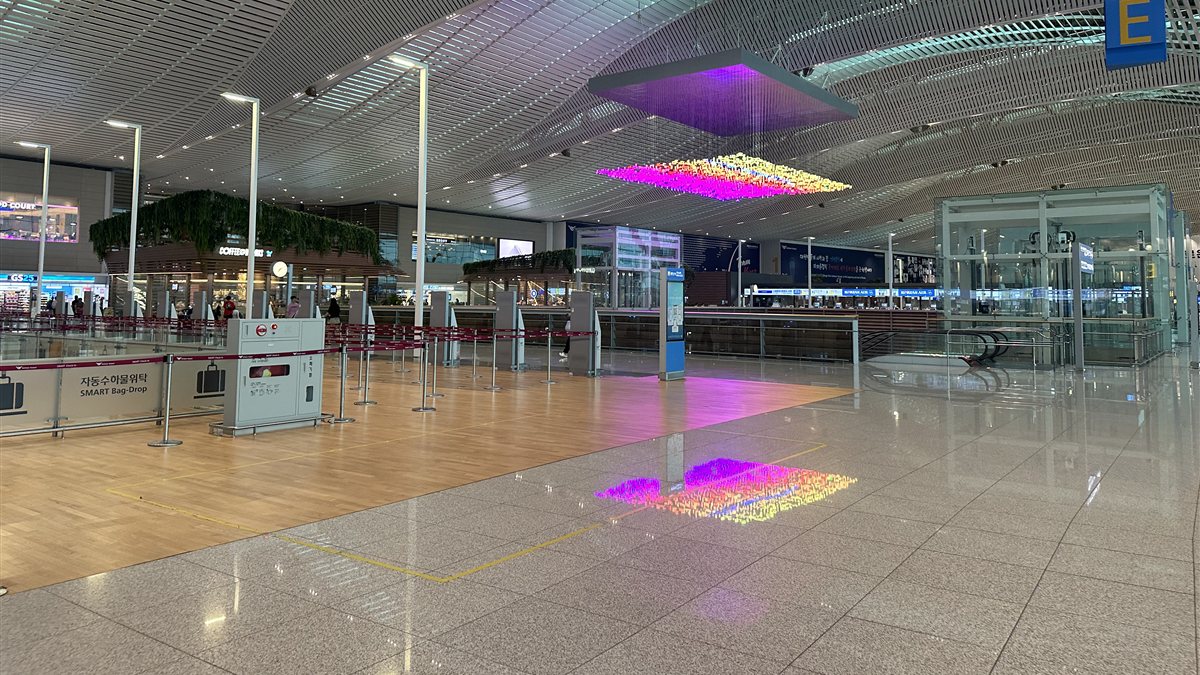
For general refunds, the goods need export clearance before they leave with you, and customs may ask to inspect them. Incheon Airport describes the order like this:
- Check in. The airport advises carrying refund-eligible items and their documents with you rather than checking them.
- If they are in a checked bag, tell the airline staff at check-in. The bag is tagged for customs inspection and you take it back.
- Scan your passport at the refund kiosk in the departure hall. If the kiosk says your items need a customs inspection, show your passport, the unopened and unused goods and the purchase confirmation at the customs desk.
- A checked bag that customs has cleared goes onto the oversized baggage belt next to the customs desk.
- After security and immigration, collect the refund at the refund counter or kiosk in the duty-free area, or use the mailbox or mobile option.
Customs confirmation is described as an essential requirement: without it, there's no refund. If you miss it, the Korea Tourism Organization says you can still claim on a later trip, if you bring the goods and the voucher back within the voucher's validity period and get the customs check when you leave Korea again.
Incheon Airport lists these refund counters, both in the 3rd-floor duty-free area (after security and immigration):
| Refund counter | Counter hours | Refund kiosk | |
|---|---|---|---|
| Terminal 1 | Near Gate 28 | 07:00–22:00 | 24 hours, near Gate 28 |
| Terminal 2 | Near Gate 253, across from Gate 250 | 07:00–21:30 | 24 hours, same area |
The airport says its information is for reference only, so allow extra time and follow the signs on the day.
Source: Incheon International Airport — domestic tax refund and Korea Tourism Organization — comprehensive tax refund guide (FAQ); checked Oct 23, 2026.
How much you actually get back
Don't expect the full 10% VAT. The Korea Tourism Organization puts the refund at roughly 5–8% of the purchase price after the refund company's processing fee, depending on the price, the company and how you're paid. Taking the refund on a credit card or by mobile payment adds a separate fee, so taking cash at the counter avoids that extra fee. On a ₩100,000 purchase, 5–8% works out to about ₩5,000–₩8,000.
Source: Korea Tourism Organization — comprehensive tax refund guide (FAQ); checked Oct 23, 2026.
Duty-free or tax refund?
They're different systems. Duty-free shops at airports and in the city sell goods without customs duty or consumption taxes. Tax refund stores sell at normal prices and give back the VAT and individual consumption tax afterwards. For general refunds there's no overall spending limit, just the ₩15,000 minimum per purchase; instant refunds have the limits above. Either way, when you take purchases to another country, that country's import and duty-free rules apply. Korea's US$800 traveler allowance is for goods brought into Korea, not a universal allowance for taking purchases home.
Source: Korea Tourism Organization — comprehensive tax refund guide (FAQ) and Korea Customs Service — customs clearance guide for passengers; checked Oct 23, 2026.
Before you shop, and before you fly
- Carry your passport when you shop.
- Look for the "Tax Refund" sign, and spend ₩15,000 or more in one transaction.
- Ask for the tax refund documents, not just a receipt.
- Keep tax-free goods unopened and unused.
- At the airport, finish the refund kiosk and any customs inspection before your goods leave your hands.
- Take the goods out of Korea within 3 months of buying them.
For the rest of your trip planning, see our first-timer checklist and paying in Korea.
Source: Korea Tourism Organization — comprehensive tax refund guide and Incheon International Airport — domestic tax refund; checked Oct 23, 2026.
FAQ
What is the minimum purchase for a tax refund in Korea?
₩15,000 in a single transaction at a tax refund store. The amount is set in Korea's enforcement rules, in force from Jan 2, 2026.
What are the limits for an instant tax refund?
Each purchase must be under ₩1,000,000, and your instant-refund purchases since arriving in Korea can total up to ₩5,000,000.
Do I need to show my purchases at the airport?
For general refunds, keep the goods with you until export clearance is done. At Incheon you scan your passport at the refund kiosk; if it asks for a customs inspection, show your passport, the unopened goods and the purchase confirmation at the customs desk. For instant refunds, follow any customs instructions you are given.
Can I get a tax refund with my receipt?
No. You need the tax refund documents that the store issues with your purchase.
How much VAT do I get back in Korea?
About 5–8% of the purchase price after processing fees, according to the Korea Tourism Organization. A refund to a card or by mobile payment carries an extra fee.
- Korea Tourism Organization — Comprehensive tax refund guide
- Korean law — Special rules on VAT and individual consumption tax for foreign tourists (Presidential Decree, in force Jan 2, 2026; Korean)
- Korean law — Enforcement rules of the special rules (in force Jan 2, 2026; Korean)
- Incheon International Airport — Domestic tax refund
- Korea Customs Service — Customs clearance guide for passengers
Last checked Oct 23, 2026. Details can change — please confirm with the official source before you travel.
Photo credits