Seoul Subway Guide for First-Timers: Fares, Tickets and Transfers
Quick answer
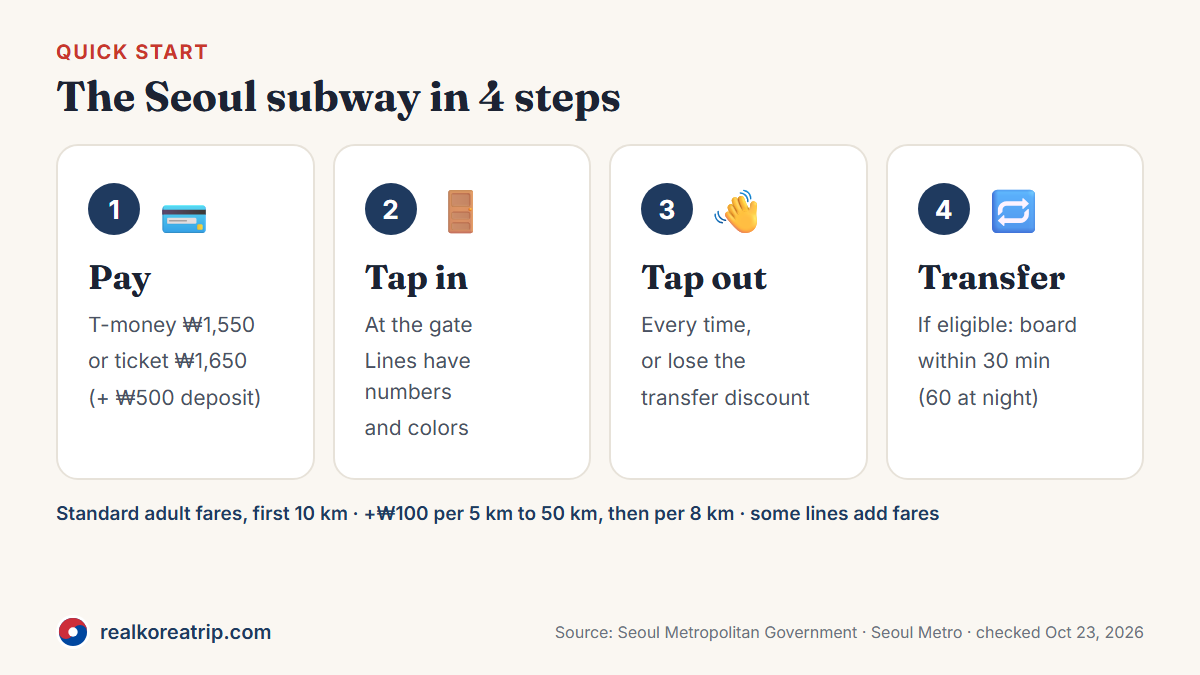
- Standard adult fares start at ₩1,550 with a transit card (T-money) or ₩1,650 with a single-journey ticket for the first 10 km. Distance charges are ₩100 per 5 km up to 50 km, then ₩100 per 8 km; some lines add separate fares.
- Tap your card when you enter and when you leave. Skip the tap on the way out and you lose the transfer discount on your next bus or train.
- Single-journey tickets add a ₩500 deposit that you get back from a refund machine at your destination.
The Seoul subway is the easiest part of a first trip to Korea, once you know three things: what to pay with, that you tap out as well as in, and that a transfer to a bus can be discounted. Station signs include English, and the lines are numbered and color-coded. What catches visitors out is the fare system, so that's most of this guide.
The short version
| Adult fare | Good to know | |
|---|---|---|
| T-money (transit card) | ₩1,550 for the first 10 km | Top up with won cash; transfer discounts with buses |
| Single-journey ticket | ₩1,650 for the first 10 km | Plus a ₩500 deposit, refunded at your destination |
| Climate Card short-term pass | ₩5,000 (1 day) to ₩20,000 (7 days) | Unlimited rides in its coverage area; card costs ₩3,000 |
| Children aged 6–12 | ₩550 | T-money must be registered with the child's date of birth; under 6 free with a guardian (up to 3 children) |
Longer trips add ₩100 for every 5 km between 10 km and 50 km, and ₩100 for every 8 km after that. Some lines, such as the Sinbundang Line, add their own separate fare.
Source: Seoul Metropolitan Government — subway fares (as of Jun 28, 2025), Seoul Metro — fare, Sinbundang Line — fares (Korean), T-money — guide for foreigners and Climate Card; checked Oct 23, 2026.
What to pay with
For most visitors, a T-money card is the default. You pay the lower card fare, you get transfer discounts between subway and bus, and the same card works on buses. For a child to get the child fare, the card has to be registered with the child's date of birth first; T-money says this is done at convenience stores or subway information centers, with the card and an ID. An unregistered card charges the adult fare. The catch: regular T-money top-ups take Korean won cash. Our T-money guide covers where to buy one and how to get your balance back.
A single-journey ticket makes sense for one or two rides. It costs ₩100 more than the card fare, works only on the subway, and you pay a ₩500 deposit on top. To buy one, pick your language on the machine, choose "Single-Journey," then find your destination by station name or station number, and pay the fare plus deposit. At the end of your ride, after you tap out, put the ticket into the "Deposit Refund Device" at your destination station to get the ₩500 back before you leave the station.
The Climate Card short-term pass is Seoul's unlimited-ride option for 1, 2, 3, 5 or 7 days. The pass starts on the day you charge it, and a 1-day pass runs until that day's last bus or train. Since October 1, 2026, it covers subway stations within Seoul and Seoul-licensed city and village buses. You can also get off at Incheon Airport Terminal 1 or 2 on the Airport Railroad after boarding within the covered area, but you can't board with the pass at those airport stations. The Sinbundang Line and airport buses are excluded, and if you get off outside the coverage area, station staff will charge you the fare for that trip. Check the official FAQ (Korean) before you buy.
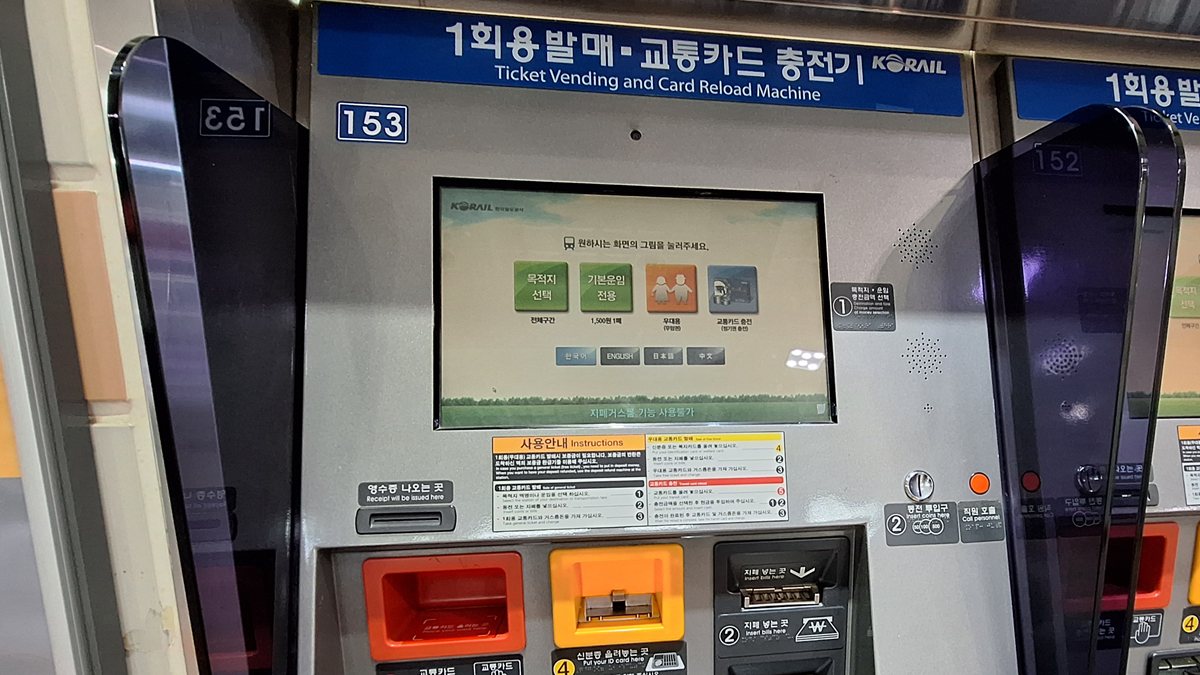
Paying by foreign card? Since March 17, 2026, the 440 new ticket machines at 273 stations on Lines 1–8 accept international cards such as Visa and Mastercard for single-journey tickets and Climate Card short-term passes, with a service fee of about 3.7%.
Source: Seoul Metro — single-journey ticket, Seoul Metropolitan Government — Climate Card and international cards at ticket machines; checked Oct 23, 2026.
Tap in, tap out
Tap your card on the reader at the gate when you go in, and again when you come out. Seoul Metro is direct about the cost of forgetting the second tap: if your card doesn't properly touch the reader when you get off, you lose the transfer discount and are charged separate fares for each ride. Climate Card short-term pass users should tap out too, though Seoul's current FAQ says missed-tap penalties don't apply to short-term passes.
There's one small reward for early starts: your first ride before 6:30 a.m. is 20% off when you pay by card.
Source: Seoul Metro — fare, Seoul Metropolitan Government — subway fares and Climate Card short-term FAQ (Korean); checked Oct 23, 2026.
Transfers: how the discount works
On standard subway lines, changing lines within the paid area doesn't add a new base fare; the journey's distance still counts. Lines such as Sinbundang charge an additional line-specific fare. Switching between the subway and a bus is where the transfer rules matter. With a transit card, a journey can include up to four transfers, for five boardings in total. Tap on and off each time, and board the next bus or train within 30 minutes of getting off, or within 60 minutes between 9 p.m. and 7 a.m. You pay the highest base fare among the services you use, plus any distance or line surcharges, rather than a new fare each time. Transfers to the same bus route or the same vehicle don't count. Single-journey tickets don't get bus transfers, since they work only on the subway.
Source: Seoul Metropolitan Government — integrated transfer discount (Korean), Seoul Metro — fare and Sinbundang Line — fares (Korean); checked Oct 23, 2026.
Finding your way
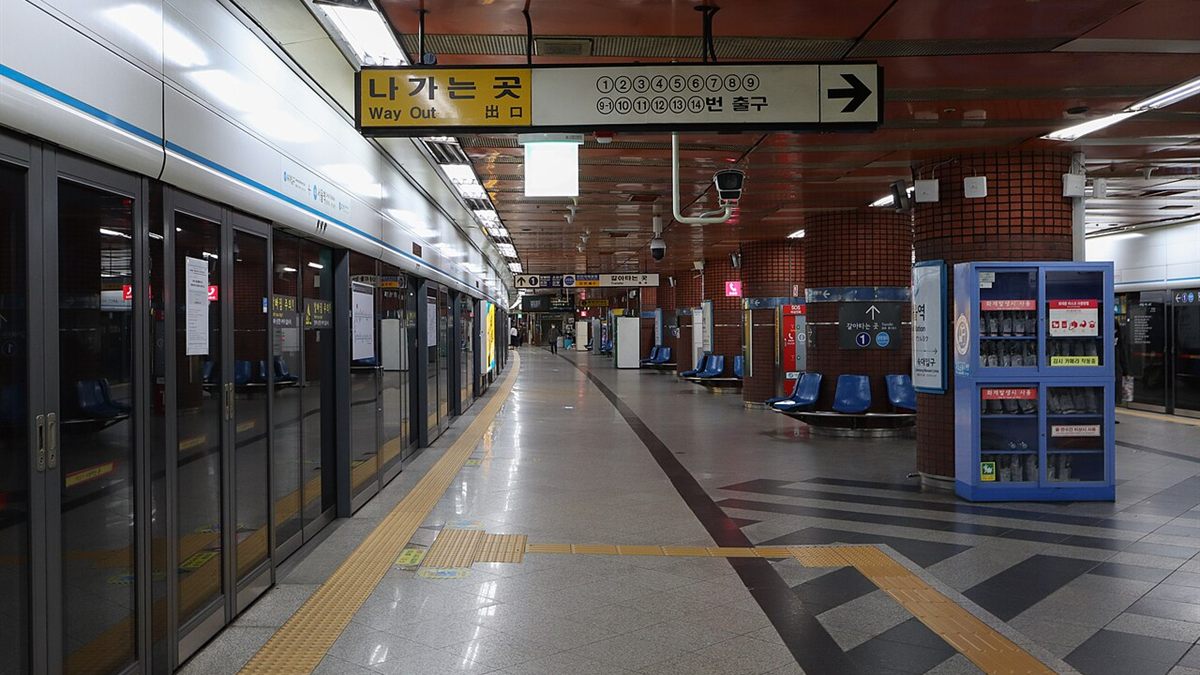
Lines have numbers and colors, and stations have numbers as well as names, which helps when a station name is long or unfamiliar. Plan routes in Naver Map, which gives transit directions in English.
Before your first ride
- Get a T-money card and some won to top it up — or plan to use a single ticket or a Climate Card pass.
- Install Naver Map and search your first route.
- Tap in at the gate. Tap out when you leave.
- Using a single ticket? After tapping out, return it at the destination station's refund machine before leaving the station.
- Heading on by bus? Board within 30 minutes (60 at night) to keep the transfer discount.
Source: Seoul Metro — single-journey ticket and Seoul Metropolitan Government — integrated transfer discount (Korean); checked Oct 23, 2026.
Arriving from the airport? See Incheon Airport to Seoul. Heading farther? See how to book KTX tickets.
FAQ
How much is the Seoul subway?
₩1,550 for adults with a transit card such as T-money, or ₩1,650 with a single-journey ticket, for up to 10 km on standard lines. Longer trips add ₩100 per 5 km up to 50 km, then ₩100 per 8 km. Some lines, such as Sinbundang, add a separate fare.
Can I use a credit card to ride the Seoul subway?
At the gates you tap a transit card or ticket. To buy one by card: since March 17, 2026, the 440 new machines on Lines 1–8 sell single-journey tickets and Climate Card short-term passes to holders of international cards such as Visa and Mastercard, with a fee of about 3.7%.
Do I get my single-ticket deposit back?
Yes. The ₩500 deposit is refunded in full when you put the ticket into the Deposit Refund Device at your destination station.
Are transfers free on the Seoul subway?
On standard lines, changing lines inside the paid area doesn't add a new base fare. Between subway and bus, a transit card gives a transfer discount if you tap on and off and board within 30 minutes (60 minutes between 9 p.m. and 7 a.m.), up to four transfers (five boardings). You pay the highest base fare among the services used, plus distance and line surcharges; transfers to the same bus route don't count.
Do children pay on the Seoul subway?
Children aged 6–12 pay ₩550 for the basic fare, but with T-money the card must first be registered with the child's date of birth, or it charges the adult fare. Children under 6 ride free with a guardian, up to three children per guardian.
- Seoul Metropolitan Government — Subway fares
- Seoul Metro — Fare
- Seoul Metro — Single-journey ticket
- Seoul Metropolitan Government — Climate Card
- Seoul Climate Card FAQ, short-term passes (Korean)
- Seoul Metropolitan Government — Integrated transfer discount (Korean)
- T-money — Guide for foreigners
- Sinbundang Line — Fares (Korean)
- Seoul Metropolitan Government — International cards for passes and single tickets (Mar 2026)
Last checked Oct 23, 2026. Details can change — please confirm with the official source before you travel.
Photo credits