What to Eat in Jeju: Black Pork, Pork Noodle Soup, Momguk and Where to Find Them
Quick answer
- Black pork (heukdwaeji) is one of Jeju's representative foods, Visit Jeju says, usually grilled and dipped in a fermented anchovy sauce called myeljeot. Many black pork restaurants also sell ordinary pork, so check what you're ordering.
- Two Jeju soups are made with pork even though their names don't say so: gogi guksu (noodles in a pork broth) and momguk (a seaweed soup made with pork bone broth). Ask first if you avoid pork.
- For a mix of dishes in one place, go to Dongmun Market in Jeju City (night market from 18:00 in Nov–Apr) or the Olle Night Market in Seogwipo (17:00–22:00 daily, Visit Jeju lists).
Jeju's food is built around black pork, buckwheat and millet, and seafood, and two of its signature soups, gogi guksu and momguk, use pork broth even though their names don't say so. Visit Jeju calls black pork (heukdwaeji) one of the island's representative foods. This guide covers what each dish is, what's in it, and where to find it: Dongmun Market in Jeju City and the Olle market and night market in Seogwipo.
Source: Visit Jeju — Traditional Jeju Island Foods and Visit Jeju — Heukdwaeji (both updated Apr 2026); checked Nov 8, 2026.
The short version
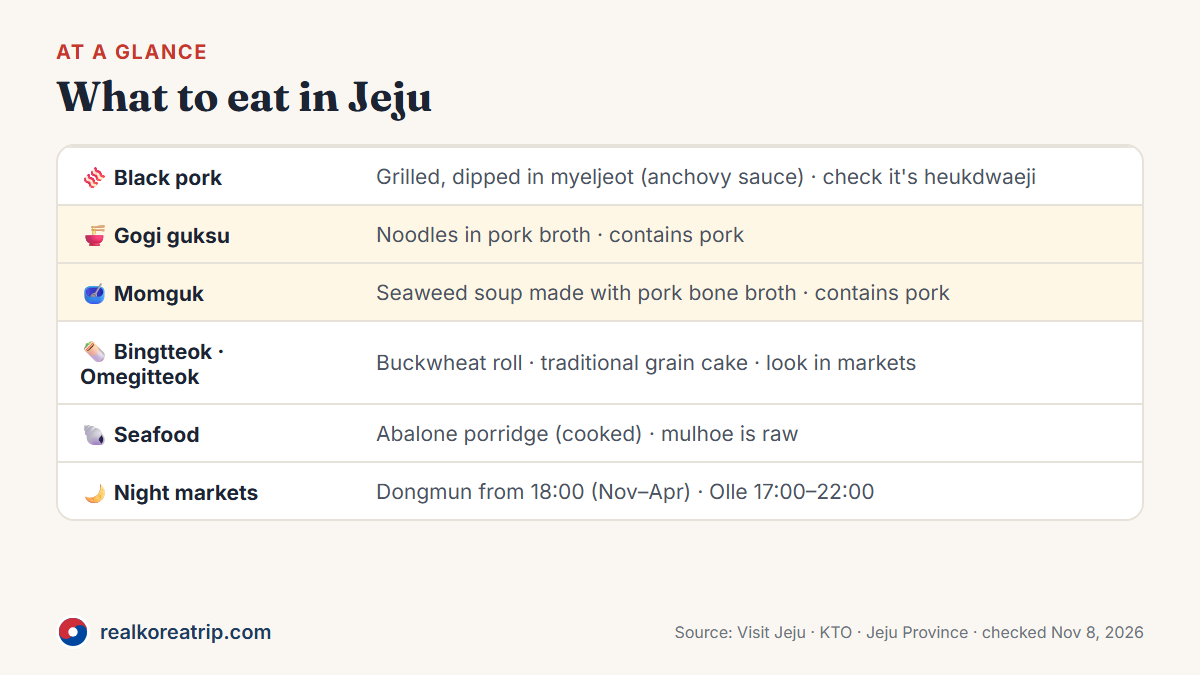
| Food | What it is | Contains pork? |
|---|---|---|
| Heukdwaeji (흑돼지) | Grilled black pork, dipped in myeljeot (anchovy sauce) | Yes |
| Gogi guksu (고기국수) | Noodles in a milky pork broth, topped with pork | Yes |
| Momguk (몸국) | Gulfweed seaweed soup made with pork bone broth | Yes |
| Dombe gogi (돔베고기) | Boiled pork, sliced and served on a wooden board | Yes |
| Bingtteok (빙떡) | Thin buckwheat pancake rolled around cooked radish | Not in the listed ingredients; ask |
| Omegitteok (오메기떡) | Traditional grain cake, made with millet or, at many modern shops, rice and mugwort | Not in the listed ingredients; ask |
| Jeonbokjuk (전복죽) | Abalone rice porridge | Not in the listed ingredients; ask |
| Mulhoe (물회) | Raw fish in a cold, sweet and spicy broth | Raw seafood |
"Not in the listed ingredients" means the official descriptions don't mention pork. It isn't a guarantee: cooking fat and broths vary by restaurant. We don't name or rank restaurants, and we list no food prices because we found no official island-wide figure.
Source: Visit Jeju — Traditional Jeju Island Foods and Jeju Province — Food culture (Korean); checked Nov 8, 2026.
Black pork: how to order it
The black pig is a native Jeju breed, small with black fur, and Visit Jeju notes it costs much more than other pork. It's usually grilled and dipped in myeljeot (멜젓), a Jeju-style fermented anchovy sauce. Some places grill bracken (gosari) or seafood such as abalone and shrimp alongside it.
What you'll see on the menu, as Visit Jeju explains it:
| Menu word | What it means |
|---|---|
| Samgyeop (삼겹) | Pork belly, the best-known cut |
| Moksal (목살) | Neck; leaner than belly |
| Geun gogi (근고기) | Geun is a unit of weight, not a cut: a thick piece sold by weight |
| Bbolsal (뽈살) | Pork chin |
Check it's black pork. Visit Jeju says a lot of heukdwaeji restaurants also serve ordinary pork, so confirm when you order.
Where to look: Black Pork Street in Jeju City (26 Gwandeok-ro 15-gil) and the Arang Joeul food street in downtown Seogwipo (2 Cheonji-ro), which Visit Jeju describes as having black pork and seafood restaurants. Opening hours vary by restaurant. For how a Korean barbecue meal works, see our Korean BBQ guide.
Source: Visit Jeju — Heukdwaeji (updated Apr 2026) and Visit Jeju — Traditional Jeju Island Foods; checked Nov 8, 2026.
Gogi guksu and momguk: pork soups with innocent names
Gogi guksu (고기국수). The broth is made from slow-boiled pork, Visit Jeju says, and its Korean-language page adds pork bones. Yellow noodles go into the milky white soup, sliced pork goes on top, and you season it with spring onions and red pepper flakes. Flavors differ a little from shop to shop.
Momguk (몸국). Mom is Jeju dialect for gulfweed, a brown seaweed. The soup is made from pork bone broth, and Visit Jeju says pig intestines too. In spring, during bracken season, the seaweed is swapped for bracken and it becomes gosari yukgaejang (고사리육개장).
Dombe gogi (돔베고기). Pork that's been boiled and sliced, named after the wooden cutting board (dombe) it's served on. These days restaurants usually use a belly cut.
If you avoid pork for religious or dietary reasons, these three are the ones to watch, because "seaweed soup" and "noodles" sound safe. Our halal food guide and vegetarian and vegan guide have phrases for asking.
Source: Visit Jeju — Traditional Jeju Island Foods (updated Apr 2026), Visit Jeju — Jeju local food theme (Korean, updated Sep 2026) and Jeju Province — Food culture (Korean); checked Nov 8, 2026.
Buckwheat and millet: Jeju's grain snacks
Jeju's volcanic soils made rice farming difficult, so buckwheat, millet and barley became important, Visit Jeju and Korea's food promotion institute explain. Two snacks come from that.
Bingtteok (빙떡). A thin buckwheat pancake rolled around cooked radish, mild in flavor. Look for it at traditional markets rather than restaurants. The province lists radish, carrot, spring onion, salt, sesame powder and sesame oil as ingredients.
Omegitteok (오메기떡). Omegi means millet in Jeju dialect, and the cake is traditionally made with glutinous millet. The Korean Food Promotion Institute notes that many modern shops instead use glutinous rice mixed with mugwort. Red-bean fillings and coatings vary, and the official descriptions differ too, so ask about the ingredients in the cake you buy. Tourists often buy it as a gift; look in rice cake shops and markets.
Source: Visit Jeju — Traditional Jeju Island Foods, Jeju Province — Food culture (Korean), Korean Food Promotion Institute (Korean) and Korea Tourism Organization — Omegitteok (Oct 2023); checked Nov 8, 2026.
Seafood: abalone, cutlassfish and cold mulhoe
| Dish | What it is | Note |
|---|---|---|
| Jeonbokjuk (전복죽) | Abalone sliced, stir-fried in sesame oil, then cooked into rice porridge | Visit Jeju says much of the island's abalone is now farmed; wild abalone is sold at Haenyeo Houses |
| Galchiguk (갈치국) | Cutlassfish soup with ripe pumpkin, green chili and napa cabbage | Cutlassfish is caught mostly in September and October, the province says |
| Seongge-guk (성게국) | Sea urchin soup with seaweed; Jeju also calls urchin gusal | Sea urchin is caught mostly late May to June |
| Haemul ttukbaegi (해물뚝배기) | Seafood in a doenjang (soybean paste) stew | With small abalone, clams, urchin roe, squid, shrimp |
| Okdom-gui (옥돔구이) | Grilled tilefish, half-dried in the sun and brushed with sesame oil | Fish caught November to March, per the province |
| Jari mulhoe / Hanchi mulhoe (자리물회 / 한치물회) | Raw damselfish or squid in a cold, sweet and spicy broth | Raw; eaten mostly in summer |
Haenyeo Houses serve seafood harvested by Jeju's women divers (haenyeo), Visit Jeju says. The divers go down without oxygen masks to gather abalone and sea urchins. Their culture is on UNESCO's Representative List of the Intangible Cultural Heritage of Humanity (2016).
Source: Visit Jeju — Traditional Jeju Island Foods, Jeju Province — Food culture (Korean) and UNESCO; checked Nov 8, 2026.
Where to go: markets and night markets
| Dongmun Market (Jeju City) | Seogwipo Maeil Olle Market | Olle Night Market (Seogwipo) | |
|---|---|---|---|
| Hours | Stalls keep their own hours. KTO lists 07:00–21:00 on one page and 08:00–21:00 on another | Winter hours 07:00–20:00; varies by store | 17:00–22:00 daily (Visit Jeju) |
| Night market | From 18:00 in Nov–Apr; KTO lists 19:00 in May–Oct; until 24:00 | — | Food only, with tables and chairs |
| Closed | Open year-round (KTO) | Open year-round | Listed as open daily, rain or shine |
| What you'll find | Hallabong, omegitteok, meat noodles, seafood, a night food market | Mandarins, hallabong, fish, black pork products | Grilled snacks and dishes; varies by stall |
| Address | 20 Gwandeok-ro 14-gil, Jeju-si (night market: 16 Gwandeok-ro 14-gil) | 18 Jungang-ro 62beon-gil, Seogwipo-si | 20 Jungjeong-ro 61beon-gil, Seogwipo-si |
Visit Jeju notes Dongmun Market is near Jeju International Airport, which makes it an easy first or last stop. These hours come from tourism pages, not the markets' own sites, so treat them as a guide.
Source: KTO — Major Shopping Streets, KTO — Dongmun Market, Visit Jeju — Night Life (updated Apr 2026), Visit Jeju — Olle Market, KTO — Olle Market and Visit Jeju — Olle Night Market; checked Nov 8, 2026.
In season now: mandarins and yellowtail (November 2026)
Open-field early mandarins are harvested in November and December, Jeju's agricultural research service says, and Korea's food promotion institute describes winter as yellowtail (bangeo) season at Moseulpo. Two events fall in the same week:
| Southernmost Bangeo (Yellowtail) Festival | Jeju Citrus Expo | |
|---|---|---|
| Dates | Nov 19–22, 2026 | Nov 19–23, 2026 |
| Where | Moseulpo Port, Daejeong-eup, Seogwipo | Seogwipo Agricultural Technology Center grounds (our translation), Namwon-eup |
| Hours | Check the organizer's notices | 10:00–17:00 (exhibition halls until 16:30) |
| Admission | Not listed for 2026 in the sources we checked | ₩2,000 on site. Free for children under 13 and adults 65+ on the expo's list |
For the ₩1,000 price, you reserve a visit date on the expo's Korean-language site by Nov 18 (an account is needed). It isn't an online payment: you buy the discounted ticket at the expo, and the expo says to bring ID that matches the booking. We couldn't confirm whether visitors from abroad can book.
Source: Visit Jeju — Bangeo Festival (Korean), Jeju Citrus Expo — Visitor guide (Korean), Korean Food Promotion Institute (Korean) and Jeju Agricultural Research and Extension Services (Aug 2021, Korean); checked Nov 8, 2026.
See the haenyeo: museum and performance
| Jeju Haenyeo Museum | |
|---|---|
| Hours | 09:00–18:00; tickets until 17:00 |
| Closed | Mondays (when a Monday is a public holiday it opens and closes the next working day instead, as in Oct 2026), Jan 1, Seollal and Chuseok |
| Admission (non-residents) | Adults 25–64 ₩1,100; ages 13–24 ₩500. Free for 12 and under and 65+ on the museum's exemption list. We suggest carrying ID |
| Bus | From Jeju Bus Terminal, bus 201 to Haenyeo Museum entrance (5-min walk) or bus 260 to Haenyeo Museum, the museum says |
At Seongsan Ilchulbong, Visit Jeju lists a haenyeo performance once a day at 14:00 on the free section near Umutgae coast. It lasts about 5–10 minutes, depends on weather and conditions, and you won't see the divers actually harvesting. Visit Jeju says to call first: 064-783-1135.
Source: Jeju Haenyeo Museum — Visitor information, Directions and Oct 2026 notice (Korean), and Visit Jeju — Haenyeo performances (Korean, updated Sep 2026); checked Nov 8, 2026. More on getting around: our Jeju travel guide.
Ordering tips from Visit Jeju
- "Minimum 2 orders" on a dish usually means it comes in one pot or plate for sharing, Visit Jeju explains. It's about the serving, not a rule against eating alone.
- Small restaurants often have no menu book. Look for the menu on a banner or on the wall.
- Ask for apjeobsi (앞접시), small plates or bowls for sharing.
Source: Visit Jeju — Traditional Jeju Island Foods; checked Nov 8, 2026.
Raw seafood: one health note
Korea's disease agency says Vibrio sepsis can come from raw or undercooked seafood and shellfish, and shows up especially from May to November among high-risk people, such as those with liver disease or weakened immunity. Its advice is to cook seafood thoroughly. That's general national health guidance, not a warning about Jeju or any market.
Source: KDCA (updated Apr 2026, Korean); checked Nov 8, 2026.
Before you go
- Avoiding pork? Gogi guksu, momguk and dombe gogi all contain it.
- Ordering black pork: confirm it's heukdwaeji, not ordinary pork.
- Dongmun night market: from 18:00 in winter months, until midnight.
- Visiting in late November 2026? The yellowtail festival (Moseulpo, Nov 19–22) and citrus expo (Seogwipo, Nov 19–23) overlap on Nov 19–22.
- Haenyeo Museum: usually closed Mondays (check holiday exceptions); last tickets 17:00.
- For interpretation, call the 1330 Korea Travel Hotline (+82-2-1330 from abroad).
FAQ
What food is Jeju famous for?
Visit Jeju calls black pork (heukdwaeji) one of the island's representative foods. Gogi guksu (pork noodle soup), momguk (seaweed soup with pork bone broth), abalone porridge and omegitteok, a traditional grain cake, are other Jeju specialties covered here.
Is gogi guksu made with pork?
Yes. The broth is made from slow-boiled pork, and Visit Jeju's Korean page adds pork bones, with sliced pork on top.
Is momguk vegetarian?
No. Momguk is a gulfweed seaweed soup, but it's made with pork bone broth and, Visit Jeju says, pig intestines.
Where can I eat in Jeju at night?
Dongmun Market's night market in Jeju City runs from 18:00 to 24:00 in November to April (KTO lists 19:00 from May to October), and the Olle Night Market in Seogwipo is listed at 17:00–22:00 daily.
When is mandarin season in Jeju?
Open-field early mandarins are harvested in November and December. The 2026 Jeju Citrus Expo runs Nov 19–23.
- Visit Jeju — Traditional Jeju Island Foods (updated Apr 2026)
- Visit Jeju — Heukdwaeji (Black Pork) (updated Apr 2026)
- Visit Jeju — Night Life in Jeju (updated Apr 2026)
- Visit Jeju — Olle Night Market
- Visit Jeju — Seogwipo Maeil Olle Market
- Visit Jeju — 26th Southernmost Bangeo Festival (Korean)
- Visit Jeju — Haenyeo performances (Korean, updated Sep 2026)
- Visit Jeju — Jeju local food theme (Korean, updated Sep 2026)
- Korean Food Promotion Institute — Jeju's taste 1 (Korean)
- Korean Food Promotion Institute — Jeju naturalism (Korean)
- Jeju Agricultural Research and Extension Services — Answer on citrus types (Korean, Aug 2021)
- Jeju Special Self-Governing Province — Food culture (Korean)
- Jeju Haenyeo Museum — Visitor information (Korean)
- Jeju Haenyeo Museum — Directions (Korean)
- Jeju Haenyeo Museum — Closing-day notice, Oct 2026 (Korean)
- UNESCO — Culture of Jeju Haenyeo (women divers)
- Jeju Citrus Expo organizing committee — Visitor guide (Korean)
- Korea Tourism Organization — Major Shopping Streets in Korea
- Korea Tourism Organization — Dongmun Traditional Market
- Korea Tourism Organization — Millet Rice Cake (Omegitteok) (Oct 2023)
- Korea Tourism Organization — Seogwipo Maeil Olle Market
- Korea Disease Control and Prevention Agency — Vibrio vulnificus sepsis (Korean, updated Apr 2026)
Last checked Nov 8, 2026. Details can change — please confirm with the official source before you travel.
We publish new guides regularly and update old ones when fares, rules or hours change. Follow our free RSS feed in any feed reader (such as Feedly or Inoreader), or check the latest guides on our homepage.