Vegetarian and Vegan in Korea: What to Eat and What to Ask
Quick answer
- Korean food is often made with meat or fish broth, and many restaurants have no separate vegetarian menu, the Korea Tourism Organization (KTO) says. Tell the server your diet clearly and name what to leave out.
- Ask about anchovy stock and jeotgal (salted seafood). Kimchi seasoning most often contains salted seafood or fish sauce, KTO says, and tofu stews and braised tofu mostly add salted shrimp.
- Temple food leaves out meat, fish and five pungent vegetables, but not dairy. On packaged food, Korea's 2023 VEGAN labeling guideline counts honey and beeswax as animal ingredients and says it isn't legally binding.
Korean food is often prepared with meat or fish broth, and many restaurants don't have a separate vegetarian menu, so tell the server clearly what you don't eat, the Korea Tourism Organization (KTO) advises. Kimchi most often contains salted seafood or fish sauce, many noodle soups start with anchovy stock, and temple food leaves out meat, fish and five pungent vegetables but not dairy.
Source: KTO — Tips for vegetarians (last updated Oct 2023), Korean Food Promotion Institute and Korean Temple Food (Korean); checked Oct 31, 2026.
The short version
| What to know | |
|---|---|
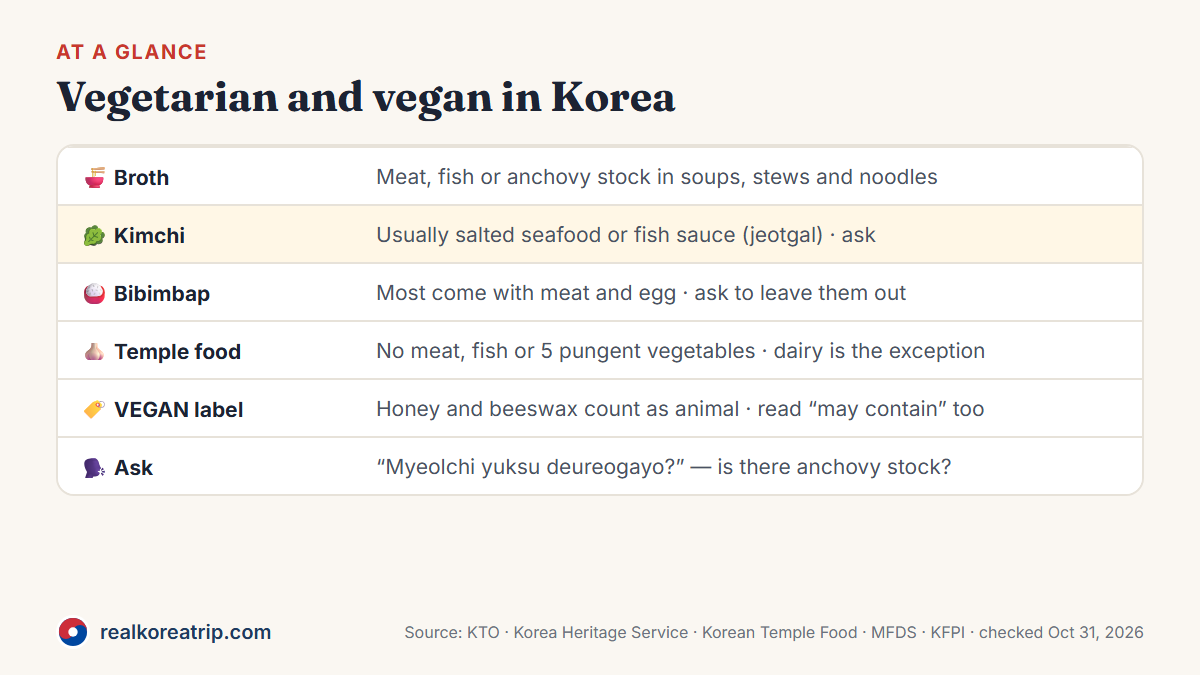
| The main catch | Broth: meat, fish or anchovy stock in soups, stews and noodles |
| Kimchi | Usually seasoned with salted seafood or fish sauce |
| Bibimbap | Most come with meat and egg on top; ask to leave them out |
| Temple food | No meat, fish or five pungent vegetables; dairy is the exception |
| Packaged food | Look for 비건 / VEGAN; read the "may contain" line too |
| Help in English | 1330 Korea Travel Hotline |
Source: KTO, Korean Temple Food (Korean) and MFDS guideline (Korean); checked Oct 31, 2026.
Where meat and fish hide
Leaving out the meat you can see isn't enough. Check these:
| Hidden ingredient | Where it shows up |
|---|---|
| Anchovy stock (멸치 육수, myeolchi yuksu) | Janchi-guksu (banquet noodles), kalguksu (knife-cut noodles) and the fish-cake skewers sold at street stalls |
| Meat or seafood stock | Doenjang-jjigae (soybean paste stew) is made with a stock and often meat or clams |
| Jeotgal (젓갈, salted fermented seafood) and fish sauce (액젓) | Most kimchi; kkakdugi (radish kimchi) uses salted shrimp; scallion and chive kimchi use salted anchovy |
| Salted shrimp | Soft tofu stew and dubu-jorim (braised tofu), KTO says |
| Fish cake | Tteokbokki (spicy rice cakes) |
| Meat | Bibimbap, japchae (glass noodles), nokdu-jeon (mung bean pancake), mul-naengmyeon (cold noodles in beef broth) |
| Egg | Garnish on janchi-guksu and kongguksu; in some pancake batters |
KTO says "many people assume that kimchi is a vegetarian-friendly dish," but its seasoning most often contains salted seafood, fish sauce or meat broth. Not every kimchi does, so ask.
Source: KTO — Tips for vegetarians, KTO — Bunsik and street food and Korean Food Promotion Institute — menu guide (dish entries in Korean and English); checked Oct 31, 2026.
For street food and BBQ restaurant side dishes, see our street food guide and Korean BBQ guide.
Dishes to start with (and still check)
These are usually built around vegetables, grains or beans, according to KTO and the Korean Food Promotion Institute. Recipes vary, so still ask about broth, egg and jeotgal.
| Dish | What it is | Check |
|---|---|---|
| Sanchae bibimbap (산채비빔밥) | Rice topped with wild mountain greens and gochujang | Egg or meat on top |
| Yachae gimbap (야채김밥) | Vegetable rice rolls: carrot, burdock, spinach, pickled radish | Ham, egg or crab stick, KTO says |
| Kongguksu (콩국수) | Noodles in cold soybean soup | Egg garnish; the radish kimchi served with it |
| Gamja-jeon, pajeon, beoseot-jeon | Potato, scallion and mushroom pancakes | Egg in the batter |
| Dotori-muk muchim (도토리묵무침) | Acorn jelly salad | The dressing |
| Bugak (부각) | Vegetables coated in glutinous rice paste, dried and fried | Frying oil |
Gimbap names tell you the filling: chamchi gimbap has canned tuna and cheese gimbap has cheese, KTO notes. For Jeonju's bibimbap, see what to eat in Jeonju.
Source: KTO — Tips for vegetarians and Korean Food Promotion Institute — menu guide; checked Oct 31, 2026.
Temple food: close, but check for dairy
Korean Buddhist temple food (사찰음식, sachal eumsik) became a national intangible heritage in May 2025. The Korea Heritage Service describes it as vegetarian food made without meat, fish or the five pungent vegetables (오신채, osinchae): garlic, green onion, garlic chives, wild chives and heunggeo.
- Dairy is the exception. The Korean temple food site run by the Cultural Corps of Korean Buddhism says temple food avoids all animal foods except dairy. KTO says the same.
- Restaurants may adjust it. KTO notes that at least one temple-food restaurant adds garlic and similar ingredients for general diners and asks guests who want them left out to say so a day ahead.
Source: Korea Heritage Service (May 19, 2025, Korean), Korean Temple Food (Korean), KTO — Temple food (last updated May 2025) and KTO; checked Oct 31, 2026.
Reading VEGAN labels on packaged food
Korea's Ministry of Food and Drug Safety (MFDS) published a guideline in March 2023 for food labeled 비건 or VEGAN:
- No animal ingredients at any stage, including additives and processing aids. Its examples include meat, seafood, eggs, milk, lactose, honey, propolis and beeswax.
- Limits on animal testing. The guideline restricts animal testing of the final product and during development, with exceptions for tests legally required for matters such as ingredient safety assessment.
- "May contain" can sit next to VEGAN. If proper prevention steps are in place, a product can be labeled vegan and still carry a line such as "may contain egg" or "may contain shrimp." A pack may also note that microbes were cultured using animal-derived material.
- Certification logos from Korean or overseas certifiers can be shown if the certification is valid. KTO lists several certifiers, from Korea and abroad.
- Not legally binding. The guideline says so itself. That applies to the guideline, not to Korea's food labeling and advertising law in general.
Source: MFDS — Vegan labeling and advertising guideline (Mar 2023, Korean) and KTO — Tips for vegetarians; checked Oct 31, 2026.
Saying it in Korean
KTO suggests preparing phrases such as "I am a vegetarian" in advance. KTO doesn't give the Korean, so these are our own simple phrases. Vegans will want the last one too:
| English | Korean | Say it |
|---|---|---|
| I'm vegetarian. | 저는 채식주의자예요. | Jeoneun chaesikjuuija-yeyo. |
| Please leave out the meat and seafood. | 고기랑 해산물 빼 주세요. | Gogirang haesanmul ppae juseyo. |
| Is there anchovy stock in it? | 멸치 육수 들어가요? | Myeolchi yuksu deureogayo? |
| Is there jeotgal or fish sauce in it? | 젓갈이나 액젓 들어가요? | Jeotgarina aekjeot deureogayo? |
| No egg, please. | 계란 빼 주세요. | Gyeran ppae juseyo. |
| I don't eat milk, butter, cheese or honey either. | 우유, 버터, 치즈, 꿀도 안 먹어요. | Uyu, beoteo, chijeu, kkuldo an meogeoyo. |
Seoul City uses these terms: vegan (plant foods only), lacto (plus dairy), ovo (plus eggs), lacto-ovo (plus dairy and eggs) and pesco (plus seafood). Naming yours helps.
For interpretation, call the 1330 Korea Travel Hotline (+82-2-1330 from abroad). Halal diets have their own guide: halal food in Korea.
Source: KTO — Tips for vegetarians and Seoul Metropolitan Government (Jan 2021, Korean); checked Oct 31, 2026.
FAQ
Is it hard to be vegetarian in Korea?
It takes some asking. KTO says Korean food is often made with meat or fish broth and many restaurants have no separate vegetarian menu, but it also says vegetarian restaurants, bakeries and cafes are on the rise.
Is kimchi vegan?
Usually not. KTO says kimchi seasoning most often contains salted seafood, fish sauce or meat broth. Ask, and if a kimchi is made without jeotgal, still check for other animal ingredients.
Is bibimbap vegetarian?
Not by default. KTO says most bibimbap comes with meat and eggs on top, so ask to leave them out. Sanchae bibimbap, with wild greens, is a good place to start.
Is Korean temple food vegan?
Not always. It leaves out meat, fish and five pungent vegetables, but the Korean temple food site makes an exception for dairy.
How do I find vegan products in Korean stores?
Look for 비건 or VEGAN, or a certifier's logo, on the pack. Korea's 2023 MFDS guideline sets what the label means, but it says it isn't legally binding.
- Korea Tourism Organization — Tips for vegetarians (last updated Oct 2023)
- Korea Tourism Organization — Temple food (last updated May 2025)
- Korea Heritage Service — Temple food designated national intangible heritage (May 19, 2025, Korean)
- Korean Temple Food (Cultural Corps of Korean Buddhism) — Features of temple food (Korean)
- Ministry of Food and Drug Safety — Vegan labeling and advertising guideline (Mar 2023, Korean)
- Korean Food Promotion Institute — Korean menu guide (Korean and English)
- Korea Tourism Organization — Bunsik and street food
- Korea Tourism Organization — Temple food restaurant example
- Seoul Metropolitan Government — Vegetarian types explained (Jan 2021, Korean)
Last checked Oct 31, 2026. Details can change — please confirm with the official source before you travel.
We publish new guides regularly and update old ones when fares, rules or hours change. Follow our free RSS feed in any feed reader (such as Feedly or Inoreader), or check the latest guides on our homepage.