Korean BBQ for First-Timers: How to Grill, Wrap and Order

Quick answer
- At a Korean BBQ restaurant (gogi-jip), you grill the meat at your table. Some places have staff grill it for you; most tables have a vent that pulls up the smoke.
- Start with samgyeopsal (grilled pork belly), which the Korea Tourism Organization calls the most popular Korean meat dish. Eat it with salt and sesame oil, or wrapped in lettuce.
- To make a wrap (ssam), put meat on lettuce or a perilla leaf, add ssamjang sauce and eat it in one bite. Finish with soybean paste stew or fried rice.
At a Korean BBQ restaurant, called a gogi-jip ("meat restaurant"), you grill meat at your table, wrap it in lettuce or a perilla leaf with ssamjang sauce, and eat each wrap in one bite. The Korea Tourism Organization calls samgyeopsal (grilled pork belly) the most popular Korean meat dish. Most tables have a vent for the smoke, and at some places staff grill the meat for you.
Below: what to order, how to make a wrap, how to finish the meal and how to get help.
Source: Korea Tourism Organization — About Korean Food (page dated Jul 25, 2025); checked Oct 26, 2026.
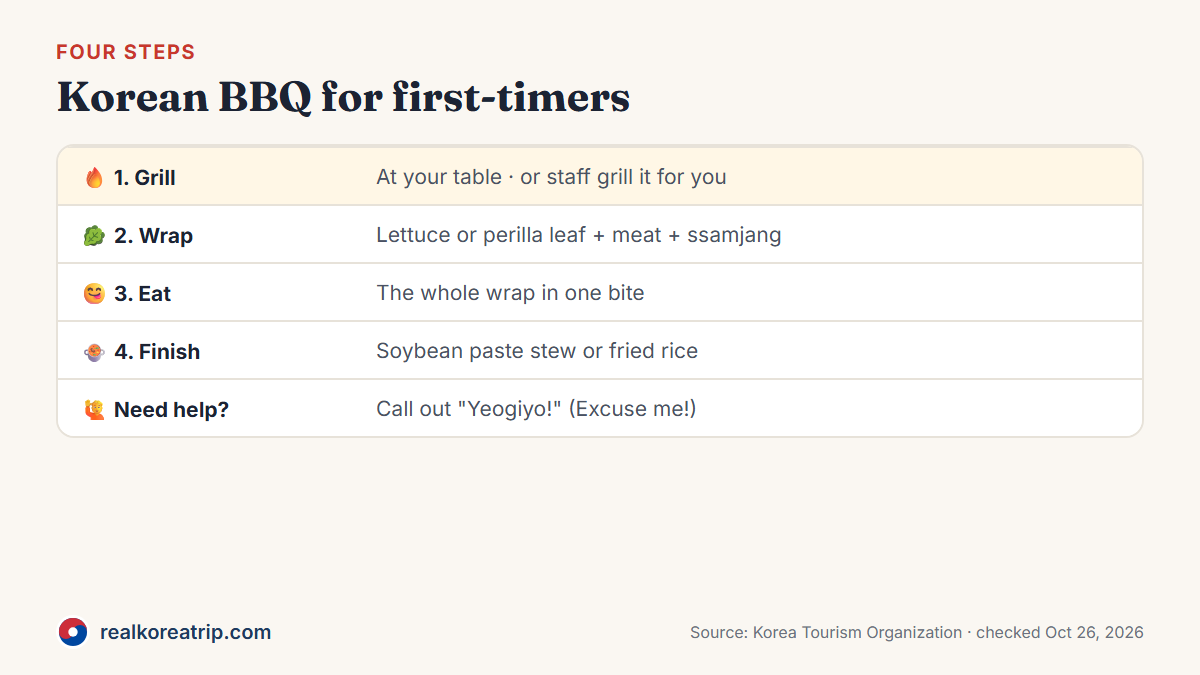
The short version
| Step | What happens |
|---|---|
| 1. Grill | You grill the meat at your table; at some places staff do it and tell you when it's ready |
| 2. Wrap | Meat on lettuce or a perilla leaf, plus ssamjang sauce |
| 3. Eat | The whole wrap in one bite |
| 4. Finish | Doenjang-jjigae (soybean paste stew) or fried rice |
| Need help? | Call out "Yeogiyo!" (Excuse me!) |
Source: Korea Tourism Organization — About Korean Food; checked Oct 26, 2026.
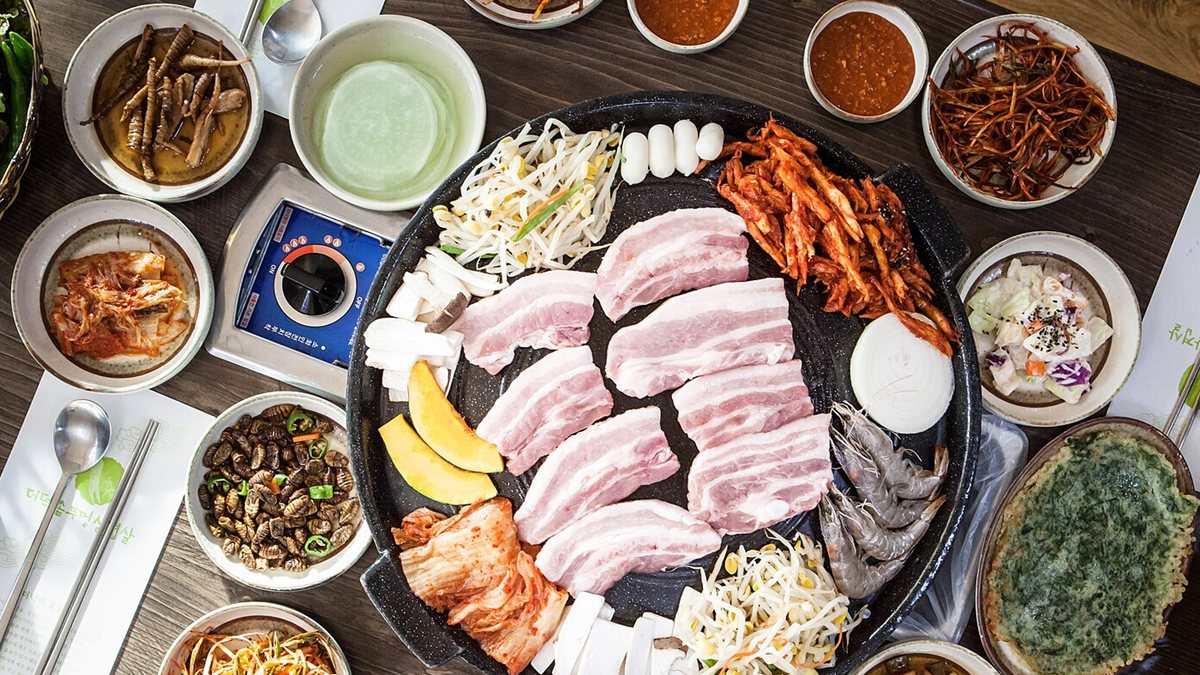
What to order
| Dish | What it is | How it's eaten |
|---|---|---|
| Samgyeopsal (grilled pork belly) | Fatty, tender pork belly, one of Koreans' favorite pork cuts | With chili-soybean paste, or sesame oil and salt; in lettuce, or with garlic |
| Dwaeji-galbi (pork ribs) | Pork galbi marinated in soy sauce or red chili paste; more affordable than beef ribs | Grilled at the table |
| Galbi (beef ribs) | Usually marinated in soy sauce; salt-seasoned galbi is lighter | Grilled |
| Bulgogi | Thin beef slices in a marinade made with vegetables and fruit such as onion and pear | Pan-fried; nowadays cooks add broth or water instead of grilling it crisp |
The Korea Tourism Organization adds that some restaurants have a charcoal grill built into the table.
Source: Korea Tourism Organization food guides for samgyeopsal, pork galbi, salted galbi and bulgogi; checked Oct 26, 2026.
How to make a wrap (ssam)
- Take a lettuce or perilla leaf.
- Add a piece of grilled meat.
- Add ssamjang, a sauce of red chili paste and soybean paste mixed with garlic, scallions and sesame oil.
- Open wide and eat it all in one bite: that's the Korea Tourism Organization's tip.
Source: Korea Tourism Organization — About Korean Food; checked Oct 26, 2026.
Finishing the meal
| Dish | What it is |
|---|---|
| Doenjang-jjigae | Soybean paste stew with tofu, mushrooms, zucchini and clams, eaten with rice |
| Fried rice | Rice fried to finish the meal |
At a gogi-jip you also eat the meat with side dishes, stews and noodles, the Korea Tourism Organization says.
Source: Korea Tourism Organization — About Korean Food and Soybean Paste Jjigae; checked Oct 26, 2026.
Practical tips
| What to know | |
|---|---|
| Calling staff | Say "Yeogiyo!" (Excuse me!) to order more or ask a question; if there's a call bell, press it |
| Tipping | Not needed; extra water or complimentary side dishes don't cost more (anything you order separately does) |
| Ordering | Menus vary: ask staff how portions are sold, and whether they'll grill or you should |
| Smoke and smells | Most tables have a vent; some chairs open up to store your coat away from food smells |
| Chopsticks | Using a spoon alongside them is fine |
| Outdoor tables | "Yajang," tables set up outside the restaurant, are getting popular |
Source: Korea Tourism Organization — About Korean Food; checked Oct 26, 2026. More: Korean etiquette and Korean street food.
FAQ
How do you eat Korean BBQ?
Grill the meat at your table (or let staff do it), put it on a lettuce or perilla leaf with ssamjang sauce, and eat the wrap in one bite. Finish with soybean paste stew or fried rice.
What is samgyeopsal?
Grilled pork belly. The Korea Tourism Organization calls it the most popular Korean meat dish and suggests eating it with chili-soybean paste, or sesame oil and salt, or wrapped in lettuce.
What's the difference between galbi and bulgogi?
Galbi is ribs, usually marinated in soy sauce and grilled; pork galbi is a more affordable choice than beef. Bulgogi is thinly sliced, marinated beef that is pan-fried, nowadays with broth or water added.
Do I have to grill the meat myself?
Not always. At some Korean BBQ restaurants, staff grill the meat for you and tell you when it's ready to eat.
Do you tip at Korean BBQ restaurants?
No. The Korea Tourism Organization says there's no need to tip at Korean restaurants.
- Korea Tourism Organization — About Korean Food
- Korea Tourism Organization — Grilled Pork Belly (Samgyeopsal)
- Korea Tourism Organization — Grilled Spareribs (Dwaejigalbi)
- Korea Tourism Organization — Bulgogi
- Korea Tourism Organization — Grilled Salted Galbi
- Korea Tourism Organization — Soybean Paste Jjigae (Doenjangjjigae)
Last checked Oct 26, 2026. Details can change — please confirm with the official source before you travel.
Photo credits
We publish new guides regularly and update old ones when fares, rules or hours change. Follow our free RSS feed in any feed reader (such as Feedly or Inoreader), or check the latest guides on our homepage.