What to Eat in Busan: Pork Soup, Milmyeon, Ssiat Hotteok and Where to Find Them
Quick answer
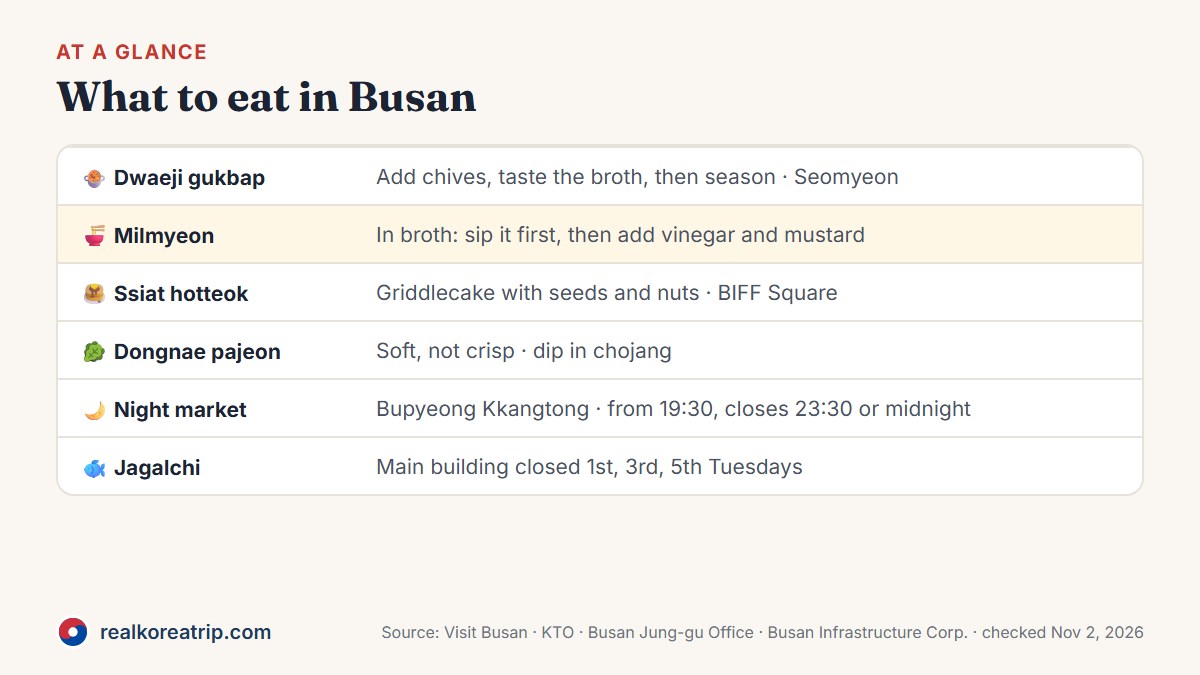
- Start with dwaeji gukbap (pork and rice soup). It came first in both parts of a 2020 Visit Busan website survey: milmyeon (cold wheat noodles) came second among 571 Korean-site respondents, ssiat hotteok among 140 on its foreign-language sites.
- Eat like the locals describe it: add chives to the soup and taste the broth before seasoning. With cold mul-milmyeon, sip the broth first, then add vinegar and mustard. Dongnae pajeon is soft, not crisp.
- Check dates and times: Bupyeong Kkangtong night market opens at 19:30 and closes at 23:30 or midnight depending on the source. Jagalchi's main building closes on the 1st, 3rd and 5th Tuesdays.
Start with dwaeji gukbap (pork and rice soup), which came first in both parts of a 2020 Visit Busan website survey; milmyeon (cold wheat noodles) came second among 571 Korean-site respondents, and ssiat hotteok (seeded griddlecake) second among 140 on its foreign-language sites. This guide covers how to eat each dish and where to look: Seomyeon for pork soup, BIFF Square and Bupyeong Kkangtong Market for street food, and Jagalchi for seafood.
Source: Visit Busan — Delicious Busan (survey Sept 23–Oct 11, 2020), Busan Future Heritage (Jul 2025, Korean) and Visit Busan — Nampo-dong; checked Nov 2, 2026.
The short version
| Food | What it is | Look around |
|---|---|---|
| Dwaeji gukbap (돼지국밥) | Pork and rice soup | Seomyeon-ro 68beon-gil, next to Seomyeon Market |
| Milmyeon (밀면) | Cold wheat noodles, in broth or spicy sauce | We found no official street for it |
| Ssiat hotteok (씨앗호떡) | Griddlecake filled with sugar and seeds | BIFF Square, Nampo-dong |
| Eomuk (어묵) | Fish cake | Bupyeong Kkangtong Market's fish cake road |
| Nakgopsae (낙곱새) | Spicy octopus, beef intestine and shrimp | We found no official street for it |
| Gomjangeo (곰장어) | Grilled hagfish, sometimes translated "sea eel" (Korean name meokjangeo) | Jagalchi, Bujeon Station, Oncheonjang, Gijang |
| Dongnae pajeon (동래파전) | Soft scallion and seafood pancake | Dongnae Market |
| Fresh seafood | Raw fish, grilled fish, spicy fish stew | Jagalchi Market |
We don't name restaurants or rank them, and we list no prices because we found no official city-wide figure. For help choosing, Busan City publishes a food guide, Taste of Busan (부산의 맛), in Korean, English, Chinese and Japanese. The city says it's at tourist information centers and on Visit Busan.
Source: Visit Busan and Busan City (Apr 2026, Korean); checked Nov 2, 2026.
Dwaeji gukbap: how to eat it
Thin slices of pork and rice in a pork broth, served with chives and salted shrimp, and sometimes thin noodles. Busan people call chives jeongguji (정구지) rather than the standard word buchu.
- Add the chives first, then taste the broth, the Korea Tourism Organization (KTO) suggests.
- Season to taste with chopped seasoning paste, salted shrimp or salt. You can also dip a slice of pork in the shrimp.
- Put the noodles in if your bowl comes with them. Only some restaurants include them.
The menu can be confusing. KTO decodes it like this, though wording can differ by shop:
| You may see | It means |
|---|---|
| 내장만 (naejang-man) | Pork offal instead of sliced pork meat |
| 순대만 (sundae-man) | Blood sausage only |
| 섞어 (seokkeo) | A mix, such as pork with offal or sundae |
| 모둠 (modum) | Some of each |
Broth varies too. Boil only pork and it comes out clear; add bones and it turns rich. Busan shops do it both ways.
Where it came from: Busan's Future Heritage project says the origin is unclear and cites two stories: Korean War refugees, or a market dish from Miryang that spread during the war. KTO's pages give other versions, so treat any single origin story as just that.
Where to look: Seomyeon's pork soup alley, around Seomyeon-ro 68beon-gil next to Seomyeon Market. Busan's Future Heritage project also names the Jobang area in Beomil-dong and around Nampo-dong and Jungang-dong. Seomyeon Market is about 3 minutes on foot from Seomyeon Station Exit 7 (Lines 1 and 2), Visit Busan says.
Source: KTO — K-local food trip (Korean), KTO — Pork and rice soup (Oct 2023), Busan Future Heritage (Jul 2025, Korean), Busanjin-gu Office (Dec 2019, Korean) and Visit Busan — Seomyeon Market (Korean); checked Nov 2, 2026.
Milmyeon: Busan's cold noodles
Wheat noodles, chewier than regular noodles and softer than naengmyeon, Visit Busan says. There are two kinds: mul-milmyeon in cold broth, and bibim-milmyeon with spicy sauce. Toppings are usually thin slices of meat, shredded cucumber and a boiled egg.
With mul-milmyeon, Visit Busan's advice is to sip the broth first, then add vinegar and mustard sauce to your taste.
The usual story is that North Korean refugees couldn't find buckwheat during the Korean War and made naengmyeon-style noodles with American-supplied wheat flour instead. KTO words it as "said to be." Busan designated it a local food in 2006, according to Visit Busan.
Source: Visit Busan — Delicious Busan, Visit Busan — Milmyeon (Korean) and KTO — Features of Busan's cuisine (older undated page); checked Nov 2, 2026.
Ssiat hotteok and other street food
Ssiat hotteok. A griddlecake fried in oil until golden, then cut open and filled with roasted nuts and seeds such as peanuts, pumpkin seeds, almonds and walnuts. You can find it in other regions now, but Visit Busan points to BIFF Square (it calls it BIFF Plaza) in Nampo-dong, and warns that popular stalls have long lines. If you have a nut allergy, skip it.
Eomuk (fish cake). Busan-style fish cake has a lot of fish in it, which KTO says makes it chewier and more savory. Bupyeong Kkangtong Market's fish cake road dates from the 1960s, and some shops let you sample before you buy, according to a 2023 report in Busan's city news. For the basics, see our street food guide.
Inside Bupyeong Kkangtong Market. Visit Busan calls this a food market, and names yubu-jumeoni (fried tofu pockets with glass noodles and vegetables in hot broth) and spicy glass noodles (bibim-dangmyeon). The Jung-gu Office also lists a sweet red bean porridge alley, where grilled injeolmi rice cake goes on top, and a pig's trotter alley serving cold naengchae-jokbal.
Source: Visit Busan — On the road, KTO — Ssiat hotteok (Oct 2023), Visit Busan — Nampo-dong, Visit Busan — Bupyeong Market and Jung-gu Office (Korean); checked Nov 2, 2026.
Three dishes to sit down for
Nakgopsae. The name stacks three ingredients: nakji (octopus), gopchang (beef small intestines) and saeu (shrimp). KTO says it was created in Busan. Visit Busan's tip is to put a scoop of white rice on top and mix.
Gomjangeo. KTO and Visit Busan translate it as "eel" or "sea eel," but it's hagfish (Korean name meokjangeo), a different group from true eels. You choose salt-grilled or spicy-sauced. Wrap it in lettuce with a perilla leaf, garlic and chili, then use the leftover sauce for fried rice, Visit Busan suggests. In Gijang, a Busan City News column describes a straw-fire style: you peel off the skin wearing work gloves, cut it with scissors and dip it in salted sauce. Visit Busan also describes it moving on the grill, which may matter to you.
Visit Busan lists gomjangeo alleys at Jagalchi Market, Oncheonjang, Haeundae Market and Gijang. Busanjin-gu Office describes a street in front of Bujeon Station (page updated 2019).
Dongnae pajeon. It's soft and moist rather than crisp, and you dip it in vinegared red pepper paste (chojang), not soy sauce, Visit Busan says. It has scallions and seafood on a rice-flour batter, and some recipes add beef and water dropwort. It's said to have been offered to the king in the Joseon era. KTO's article on the Dongnae hot springs area (Oncheonjang Station, Line 1) mentions several shops in the seonji-guk alley inside Dongnae Market.
Source: KTO — Nakgopsae (Oct 2023), Visit Busan — Gomjangeo (Korean), Busan City News (Jul 2021, Korean), Busanjin-gu Office (Oct 2019, Korean), Visit Busan — Dongnae pajeon (Korean), KTO — Features of Busan's cuisine and KTO — Dongnae (Korean); checked Nov 2, 2026.
Where to go: hours and subway
| Bupyeong Kkangtong Market | Night market (same place) | BIFF Square | Jagalchi Market | |
|---|---|---|---|---|
| Hours | 09:00–20:00 (Jung-gu Office); 08:00–20:00, varies by store (KTO) | From 19:30. Closes at midnight (Jung-gu Office, Visit Busan) or 23:30 (KTO) | Varies by shop | 05:00–22:00 (KTO); stalls keep their own hours |
| Closed | Open year-round, per Jung-gu Office and KTO | Listed as open year-round, but Visit Busan excepts traditional holidays | Open year-round, varies by shop | Main building: 1st, 3rd and 5th Tuesdays (operator; KTO lists 1st and 3rd only) |
| Subway | Jagalchi Station Exit 3, Line 1, about 10 min (Visit Busan) | Same | Near Nampo and Jagalchi stations, Line 1 | Nampo Station Exit 2 or Jagalchi Station Exit 10, Line 1 |
Locals call Gwangbok-dong, Nampo-dong and Bupyeong-dong together "Nampo-dong," Visit Busan says, so one trip can cover several of these.
Source: Jung-gu Office (Korean), KTO — Bupyeong Market, Visit Busan — Night market, KTO — BIFF Square, Busan Infrastructure Corporation (Korean) and KTO — Jagalchi; checked Nov 2, 2026.
Night market rules
- Keep to the right. Visit Busan says so, because stalls sit in the middle of narrow alleys.
- No two stalls are supposed to sell the same dish, a merchants' rule Busan's Future Heritage project describes. So walk it all before you choose.
- Bring cash. A KTO article says many stalls don't take cards, and to have cash or be ready to do a bank transfer. The article is undated, so this may have changed.
- Expect a mix: Visit Busan lists grilled whole pork belly, okonomiyaki, kebab and banh xeo.
The Jung-gu Office calls it Korea's first night market, opened in October 2013. The market's "kkangtong" (tin can) name comes from the canned goods sold there after the Korean War.
Source: Visit Busan — Night market, Busan Future Heritage (Oct 2025, Korean), KTO — Market tour (Korean) and Jung-gu Office (Korean); checked Nov 2, 2026.
Eating at Jagalchi
The first floor of the main building is the fish market and the second has raw fish restaurants and dried seafood, the operator says. A KTO article describes buying your fish, then eating it at a second-floor restaurant, with a table charge plus a cooking charge for spicy stew or grilled gomjangeo. Ask what's charged before you sit down. The article is undated, so we don't quote its amount.
For the rest of the market and the sights nearby, see our Busan travel guide.
Source: Busan Infrastructure Corporation (Korean) and KTO — Market tour (Korean); checked Nov 2, 2026.
A one-day eating route
| When | Where | Eat |
|---|---|---|
| Daytime | Jagalchi Market (not on the 1st, 3rd or 5th Tuesday if you want the main building) | Seafood |
| Afternoon | BIFF Square | Ssiat hotteok, street snacks |
| Late afternoon | Bupyeong Kkangtong Market (day market listed until 20:00) | Fish cake, yubu-jumeoni |
| From 19:30 | Night market, same place | Whatever the stalls have |
| Another day | Seomyeon | Dwaeji gukbap |
This is our own suggestion, built from the areas and hours above. It isn't an official course.
What's in it: check before you order
| Dish | Contains |
|---|---|
| Dwaeji gukbap | Pork; offal and sundae on some orders; salted shrimp on the side |
| Milmyeon | Broth from pork or beef bones, sometimes chicken |
| Ssiat hotteok | Peanuts and other nuts and seeds |
| Eomuk | Fish |
| Nakgopsae | Octopus, beef intestine, shrimp |
| Dongnae pajeon | Seafood such as oysters, shrimp and clams; some recipes add beef |
Raw seafood. Korea's disease agency says Vibrio sepsis can come from raw or undercooked seafood and shellfish. It mostly affects people with chronic liver disease, alcoholism or weakened immunity, chiefly in warm months, and its advice is to cook seafood thoroughly. That's general health guidance, not a warning about any one market.
For interpretation, call the 1330 Korea Travel Hotline (+82-2-1330 from abroad).
Source: KTO, Visit Busan — Milmyeon (Korean), Visit Busan — Dongnae pajeon (Korean) and KDCA (updated Apr 2026, Korean); checked Nov 2, 2026.
Before you go
- Going to Jagalchi on a Tuesday? Check whether it's the 1st, 3rd or 5th.
- Night market: arrive from 19:30, carry some cash, keep to the right.
- Near a traditional holiday, check the night market first: 051-243-1128 (Jung-gu Office listing).
- Learn 내장 and 순대 if you'd rather not have offal or sundae.
- Tell staff about allergies, especially nuts, shellfish and fish.
- Getting here from Seoul? See Seoul to Busan by KTX, bus or plane.
FAQ
What food is Busan famous for?
Dwaeji gukbap came first in a 2020 Visit Busan website survey. Milmyeon and nakgopsae followed among Korean-site respondents, and ssiat hotteok and seafood among foreign-language respondents. It's a survey of website visitors, not an official ranking.
Where can I get ssiat hotteok in Busan?
Visit Busan points to BIFF Square in Nampo-dong, near Nampo and Jagalchi stations on Line 1. Popular stalls have long lines. It's now sold in other regions too.
What time does the Busan night market open?
Bupyeong Kkangtong night market starts at 19:30. Jung-gu Office and Visit Busan say it runs to midnight, and KTO says 23:30. Visit Busan also excepts traditional holidays, so check around those dates.
Is Jagalchi Market closed on Tuesdays?
The main building closes on the 1st, 3rd and 5th Tuesdays, according to its operator, Busan Infrastructure Corporation. KTO lists only the 1st and 3rd, so go by the operator. Outdoor stalls keep their own hours.
Is milmyeon the same as naengmyeon?
No. Milmyeon uses wheat flour rather than buckwheat, and Visit Busan describes the noodles as softer than naengmyeon's. Both are cold noodle dishes.
Is gomjangeo eel?
Gomjangeo is hagfish, often sold under the Korean name meokjangeo. Tourism menus sometimes translate it as "eel", but hagfish are a different group from true eels. It's grilled with salt or spicy sauce.
- Visit Busan — Delicious Busan (2020 survey)
- Visit Busan — Enjoy Busan's taste on the road
- Visit Busan — Staying in Nampo-dong
- Visit Busan — Milmyeon (Korean)
- Visit Busan — Grilled gomjangeo (Korean)
- Visit Busan — Dongnae pajeon (Korean)
- Visit Busan — Bupyeong Kkangtong night market
- Visit Busan — Bupyeong Kkangtong Market
- Visit Busan — Seomyeon Market (Korean)
- Busan Future Heritage — Dwaeji gukbap (Korean, Jul 2025)
- Busan Future Heritage — Bupyeong Kkangtong Market (Korean, Oct 2025)
- Busan City News — Gomjangeo column (Korean, Jul 2021)
- Busan City — 2026 Taste of Busan guide (Korean, Apr 2026)
- Busan Jung-gu Office — Bupyeong Kkangtong night market (Korean)
- Busanjin-gu Office — Seomyeon pork soup alley (Korean, updated Dec 2019)
- Busanjin-gu Office — Bujeon Station gomjangeo street (Korean, updated Oct 2019)
- Busan Infrastructure Corporation — Jagalchi Market floor guide (Korean)
- Korea Tourism Organization — Dwaeji gukbap, K-local food trip (Korean)
- Korea Tourism Organization — Busan market tour (Korean)
- Korea Tourism Organization — Dongnae hot springs and pajeon (Korean)
- Korea Tourism Organization — Pork and rice soup (Oct 2023)
- Korea Tourism Organization — Nakgopsae (Oct 2023)
- Korea Tourism Organization — Ssiat hotteok (Oct 2023)
- Korea Tourism Organization — Features of Busan's cuisine (older page, undated)
- Korea Tourism Organization — Bupyeong (Kkangtong) Market
- Korea Tourism Organization — Jagalchi Market
- Korea Tourism Organization — BIFF Square
- Korea Disease Control and Prevention Agency — Vibrio vulnificus sepsis (Korean, updated Apr 2026)
Last checked Nov 2, 2026. Details can change — please confirm with the official source before you travel.
We publish new guides regularly and update old ones when fares, rules or hours change. Follow our free RSS feed in any feed reader (such as Feedly or Inoreader), or check the latest guides on our homepage.