Noryangjin Fish Market: How to Buy Seafood and Eat It Upstairs
Quick answer
- At Noryangjin, you buy seafood at a stall on the 1st floor and eat it at a restaurant upstairs. The usual arrangement, Visit Seoul says, is that you pay the fishmonger for the fish and the restaurant for side dishes, vegetables and sauces.
- Check the day's prices first. The market operator publishes daily auction prices on its website; KTO says retail prices are 10 to 20% higher than auction prices.
- Sales hours vary by section (the high-class fish section trades 24 hours; others close at 19:00 or 22:00). Take Line 1 Exit 9 or Line 9 Exit 7 at Noryangjin Station.
At Noryangjin Fish Market, a central wholesale market set up by the city of Seoul, you buy seafood at a 1st-floor stall and have it served at a restaurant on the 2nd or 5th floor. Check the operator's daily auction prices before you buy (the Korea Tourism Organization says retail is 10 to 20% higher), read the origin signs on the tanks, and note what you bought: for eligible seafood bought at retail stalls and returned unchanged within 24 hours, the operator offers an exchange or a full or partial refund for wrong species, wrong origin or poor freshness. Used or eaten products are excluded.
Source: Noryangjin Fisheries Wholesale Market (Korean/English), Visit Seoul and Korea Tourism Organization; checked Oct 31, 2026.
The short version
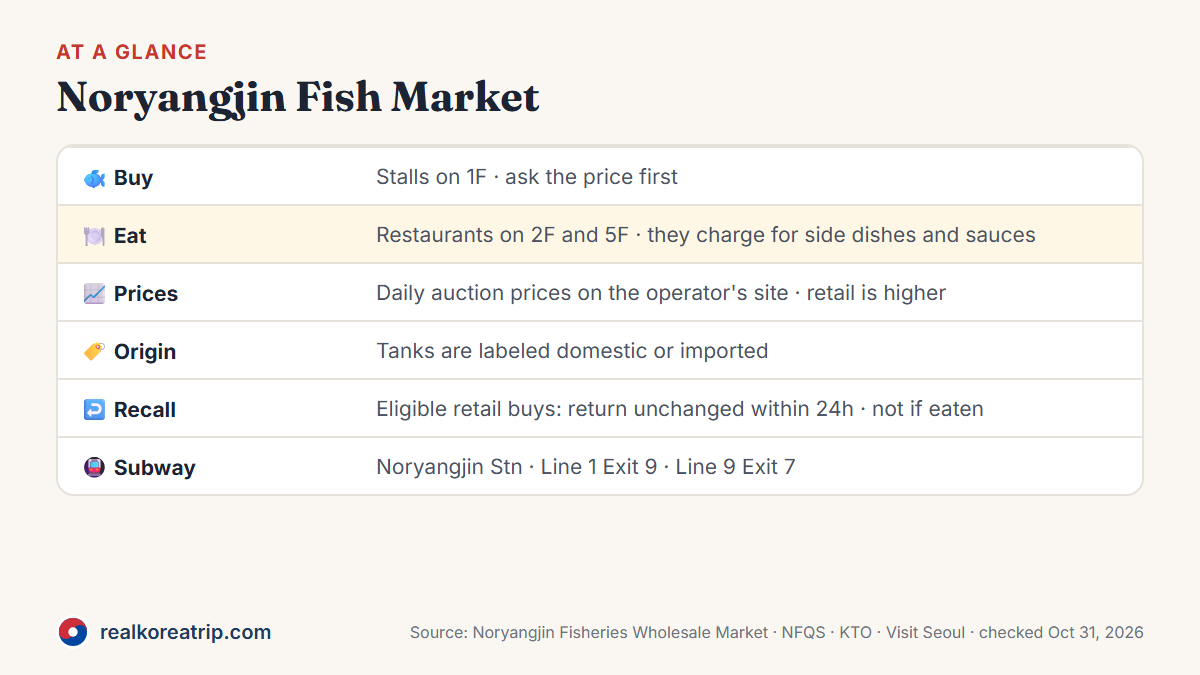
| What to know | |
|---|---|
| What it is | A central wholesale market set up by Seoul, which also sells retail |
| Floors | 1F: stalls (shellfish, live fish, fresh, frozen) · 2F: sashimi restaurants, dried fish, salted seafood, live octopus · 5F: sashimi restaurants |
| How it works | Buy at a stall, then take it to a restaurant upstairs, which charges separately for side dishes, vegetables and sauces |
| Prices | The operator posts daily auction (wholesale) prices; retail is higher |
| Open | Retail sales open year-round; hours vary by section |
| Getting there | Noryangjin Station: Line 1 Exit 9 or Line 9 Exit 7 |
Source: Noryangjin Fisheries Wholesale Market (Korean/English) and Visit Seoul; checked Oct 31, 2026.
How buying and eating works
- Check the day's prices on the operator's "today's auction prices" page. These are wholesale prices by species, origin and size, so use them for the trend, not as a stall price.
- Choose at a stall on the 1st floor. Note what you bought, from which stall, and the weight or number of fish; you'll need these for a recall.
- Take it upstairs to a restaurant on the 2nd or 5th floor. Visit Seoul says many restaurants there will slice fish bought in the market into hoe (raw fish).
- Pay twice: the fishmonger for the seafood, and the restaurant for side dishes, vegetables or sauces, as Visit Seoul describes the usual arrangement. Ask each for the price before you agree.
Source: Noryangjin Fisheries Wholesale Market — auction prices (Korean), Visit Seoul and Korea Tourism Organization; checked Oct 31, 2026.
Hours
| Section | Sales hours |
|---|---|
| High-class fish | 00:00–24:00 |
| General | 01:30–22:00 |
| Shellfish | 01:00–22:00 |
| Frozen | 03:30–22:00 |
| Salted seafood | 03:00–19:00 |
| Dried fish | 23:00–19:00 |
- Retail sales are open year-round. Auctions start between 00:00 and 03:00 depending on the category and don't run on Sundays, New Year's Day, Seollal (3 days) or Chuseok (3 days).
- On auction holidays in 2026, the market announced that its stalls and restaurants stayed open; check the notice board for each holiday.
- The operator doesn't list restaurant hours: ask at the restaurant.
Source: Noryangjin Fisheries Wholesale Market — hours and notices (Korean); checked Oct 31, 2026.
Buying with confidence
- Origin signs on the tanks. Under Korea's origin-labeling rules, sellers at wholesale and traditional markets must label origin, and when the same kind of live seafood is sold as both domestic and imported, the tanks have to keep them apart with a sign.
- 24-hour recall. The operator says seafood bought at a retail stall in the market can be exchanged or refunded (fully or in part) if the species or origin is wrong or it isn't fresh. Bring it back unchanged within 24 hours with when and where you bought it and its weight or count. It doesn't cover fish bought individually in the auction leftovers area or the basement live-fish storage, or food you've already used or eaten.
- Daily radiation tests. The operator posts seafood radiation test results on its site daily.
- If you have a chronic illness such as hepatitis or diabetes, the operator advises against eating raw shellfish and fish: have it cooked.
Source: National Fishery Products Quality Management Service (Korean), Noryangjin Fisheries Wholesale Market — recall, radiation tests and raw fish tips (Korean); checked Oct 31, 2026.
Getting there
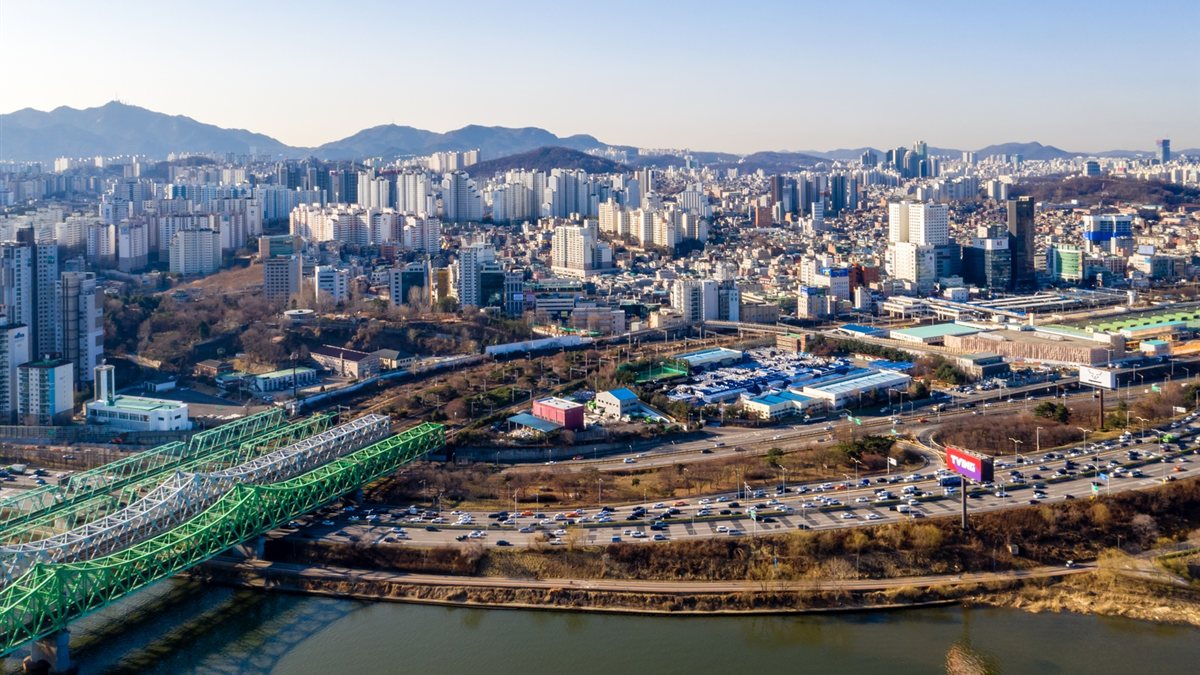
| Subway | Noryangjin Station: Line 1 Exit 9 (walk straight), or Line 9 Exit 7 then through the underpass |
|---|---|
| Bus | Get off at the Noryangjin Fish Market or CTS stop and take the underpass |
| Parking | On 3F, 4F, B1 and B2. Ask your stall or restaurant whether parking discount vouchers are available: each gives ₩1,000 of parking credit, and some businesses don't issue them. Pay any remaining charge at a machine before leaving |
| Paying in town | See our guide to paying in Korea and Seoul subway guide |
Source: Noryangjin Fisheries Wholesale Market — location and parking (Korean); checked Oct 31, 2026.
Before you go
- Check today's auction prices on the operator's site.
- Decide roughly what you'll eat and for how many people.
- Ask the stall and the restaurant for their prices before agreeing.
- Note the stall, time and weight of what you buy.
- Want to see an auction? Go before dawn on a day other than Sunday or a major holiday.
Source: Noryangjin Fisheries Wholesale Market (Korean/English); checked Oct 31, 2026.
FAQ
How does Noryangjin Fish Market work?
You buy seafood at a stall on the 1st floor, then take it to a restaurant upstairs that serves it and charges separately for side dishes, vegetables and sauces.
What time does Noryangjin Fish Market open?
Retail sales are open year-round, with hours by section: the high-class fish section trades 24 hours, while others run from early morning until 19:00 or 22:00.
How can I avoid overpaying at Noryangjin?
Check the operator's daily auction prices first (retail is higher, 10 to 20% according to KTO), ask for prices before agreeing, and keep a note of the stall and weight in case you need the 24-hour recall (eligible retail purchases, returned unchanged and not eaten).
When is the fish auction at Noryangjin?
Auctions start between 00:00 and 03:00 depending on the category. There are none on Sundays, New Year's Day, Seollal or Chuseok.
How do I get to Noryangjin Fish Market?
Take the subway to Noryangjin Station: Line 1 Exit 9, or Line 9 Exit 7 and through the underpass.
- Noryangjin Fisheries Wholesale Market — Hours, floors and location (Korean/English)
- Noryangjin Fisheries Wholesale Market — Today's auction prices (Korean)
- Noryangjin Fisheries Wholesale Market — Consumer recall (Korean)
- Korea Tourism Organization — Noryangjin Fisheries Wholesale Market
- Visit Seoul — Noryangjin Fish Market
- National Fishery Products Quality Management Service — Country-of-origin labeling (Korean)
Last checked Oct 31, 2026. Details can change — please confirm with the official source before you travel.
Photo credits
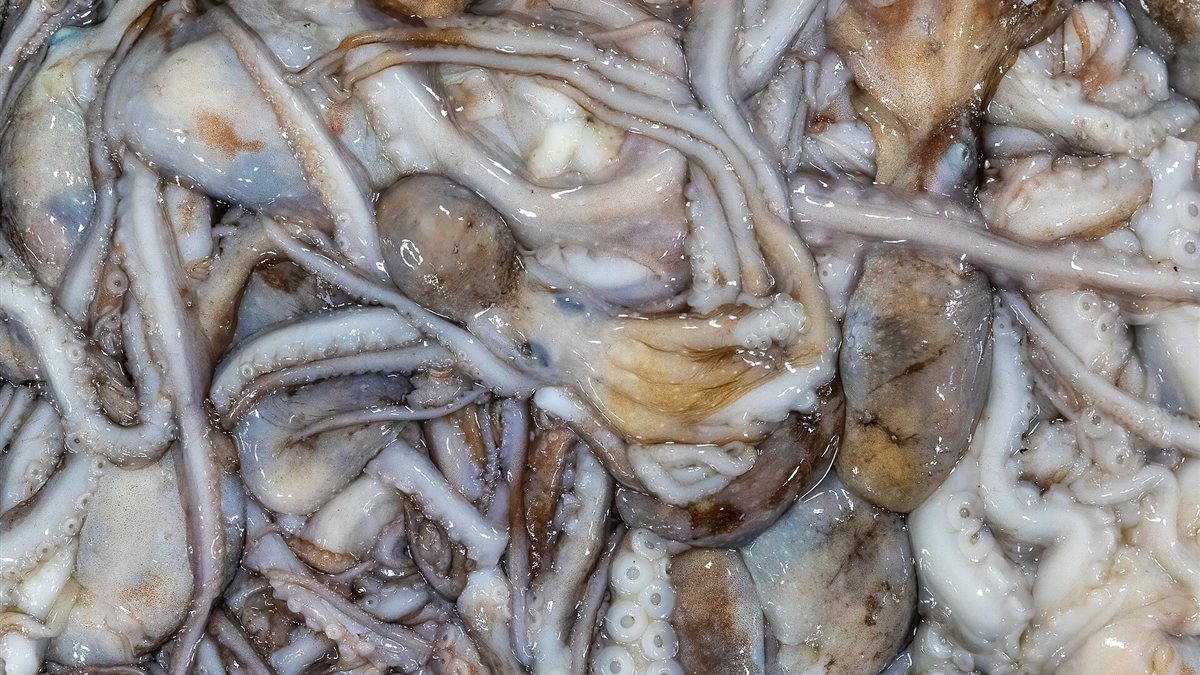
- Octopus at Noryangjin Fisheries Wholesale Market (Jun 2024) — Basile Morin, CC BY-SA 4.0, cropped (license)
- Noryangjin area along the Han River (Feb 2020) — A Photographic Record of Seoul, Seoul Metropolitan Government; provided by The Seoul Research Data Service, The Seoul Institute (https://data.si.re.kr/node/59629), CC BY 4.0, cropped (license)
We publish new guides regularly and update old ones when fares, rules or hours change. Follow our free RSS feed in any feed reader (such as Feedly or Inoreader), or check the latest guides on our homepage.