Soju vs Makgeolli: Korean Drinks Explained, from Bottle to Brewery
Quick answer
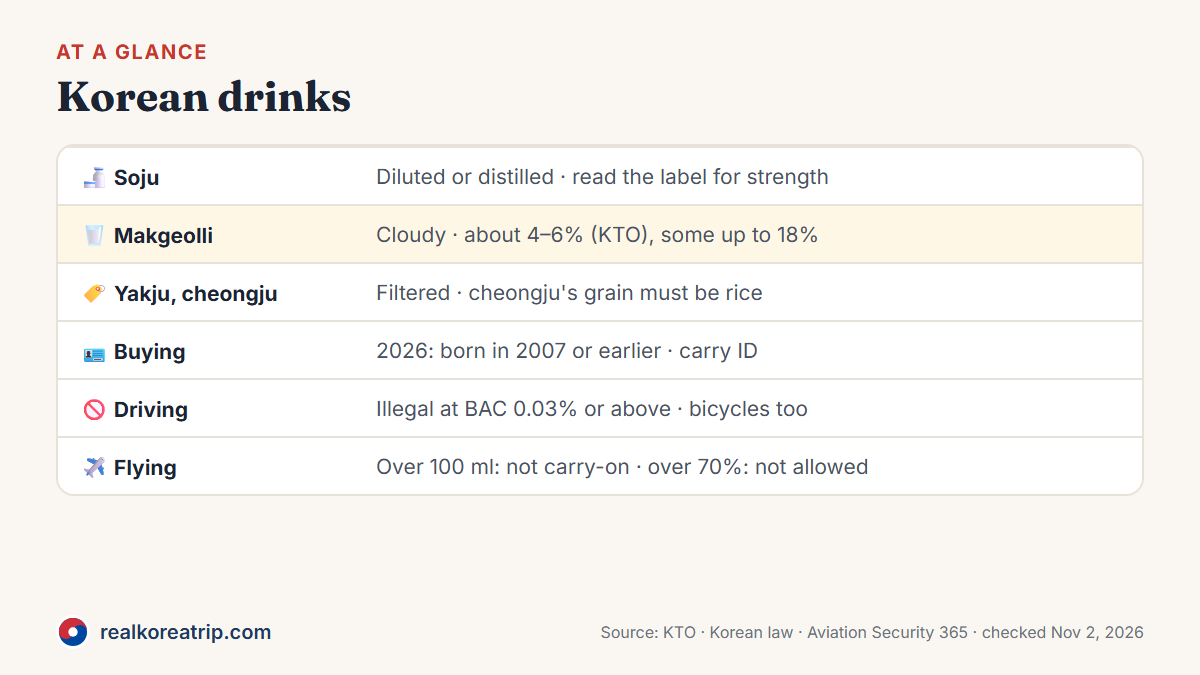
- Soju is clear and stronger; makgeolli is cloudy and lighter. KTO puts makgeolli at about 4–6% ABV, though some reach 18%. Korea's health promotion agency used 17% and 20% for soju in 2019 guidance. Read the label.
- Green-bottle soju is usually the diluted kind. Korean law separates diluted soju, made by adding water to spirit, from distilled soju. KTO says traditional liquors are the distilled ones.
- Rules: alcohol can't be sold to a 'youth,' which in 2026 means you must be born in 2007 or earlier. The drink-driving limit is 0.03%, bicycles included.
Soju is the clear, stronger liquor and makgeolli the cloudy, lighter one: the Korea Tourism Organization (KTO) puts makgeolli at about 4–6% ABV, and Korea's health promotion agency used 17% and 20% for a bottle of soju in 2019 guidance. We found no current official range for soju, and brews differ, so read the label. This guide explains the words on the bottle. It isn't a suggestion to drink.
Source: KTO — Makgeolli (Feb 2025) and Korea Health Promotion Institute (Jun 2019, Korean); checked Nov 2, 2026.
The short version
| Word on the label | What Korean law or KTO says | Strength we can source |
|---|---|---|
| Soju (소주), diluted (희석식) | Spirit diluted with water | 17% and 20% in 2019 agency guidance |
| Soju (소주), distilled (증류식) | Fermented, then distilled by a non-continuous method | Varies. Andong soju is described as 45% |
| Makgeolli (막걸리) / takju (탁주) | Cloudy, not filtered, under the takju definition | About 4–6% (KTO); up to 18% at one brewery |
| Yakju (약주) | Fermented from starch and filtered | Read the label |
| Cheongju (청주) | Filtered, and the grain must be rice | 15–18% (KTO) |
| Fruit liquor (과실주) | Fermented from fruit | Read the label |
Korean law doesn't set a general strength range for soju or takju. A label may be off by up to 0.5 degrees, and a little more for unpasteurized takju and yakju.
Source: Liquor Tax Act and annex (Korean), KTO — Makgeolli, KTO — Andong soju and KHPI (Korean); checked Nov 2, 2026.
Soju: two different things share one name
Look for 희석식 (huiseoksik, diluted) or 증류식 (jeungnyusik, distilled).
Diluted soju is what KTO calls "the commonly available soju." It's made from near-pure alcohol, derived from grains such as corn and tapioca, mixed with water and other ingredients. KTO says it's a stretch to call it traditional.
Distilled soju is made more the way whisky or brandy is, by distilling a brewed base. KTO says liquors designated as traditional are made this way with nuruk, a traditional fermentation starter.
Why the two exist: distillation is widely thought to have reached Korea from the Yuan dynasty during the Goryeo period, KTO says. The Korea Heritage Portal says a 1962 change to the Liquor Tax Act halted production of pure-grain soju, and that Andong soju came back on sale in 1990.
Source: KTO — Andong soju (Feb 2025), KFPI — Andong soju (May 2021) and Heritage Portal (Korean); checked Nov 2, 2026.
Makgeolli: the cloudy one
Say it mak-kkeol-li (our spelling). The standard Korean dictionary gives [막껄리], and calls it a cloudy liquor close in meaning to takju. Takju is the older word in the historical records, KTO says, and the one in the law.
- Filtered or not? The law defines takju as not filtered, and KTO describes makgeolli as strained in a simple way. Whichever word you use, it's the cloudy one.
- What's in it? KTO mentions rice or wheat, and the law just says starch. Don't assume it's all rice. KTO notes some add aspartame and other additives, so read the ingredients.
- *Draft makgeolli (생막걸리, saeng-makgeolli)* keeps its brewing microorganisms, which makes transport and long storage difficult, KTO says. We found no official keep-by rule, so check the date and storage line on the bottle.
- Where to find it: KTO says supermarkets and convenience stores sell it, and almost every region has at least one brewery.
For pouring etiquette, see our Korean etiquette guide.
Source: Standard Korean Dictionary (Korean), KTO — Makgeolli (Feb 2025) and Liquor Tax Act annex (Korean); checked Nov 2, 2026.
Four regional liquors
These are recognized as heritage or regional specialties. We list the drink and the place, not a maker. Bottles vary, so read the label for strength.
| Liquor | From | What makes it different |
|---|---|---|
| Andong soju (안동소주) | Andong, North Gyeongsang | Distilled soju described as 45%, then often diluted to the strength wanted. Official sources name different grains. North Gyeongsang intangible heritage since 1987 |
| Munbaeju (문배주) | Passed down from Pyeongan; registered in Gimpo | Smells of munbae (a wild pear) though no pear goes in. Made from wheat, millet and sorghum. National intangible heritage since 1986 |
| Hansan sogokju (한산소곡주) | Hansan, Seocheon | Glutinous rice, aged 100 days, about 18% |
| Jindo hongju (진도 홍주) | Jindo Island | Red color from the jicho plant (gromwell). About 40% |
If you're going to Andong, see our Andong travel guide.
Source: Heritage Portal — Andong soju, Munbaeju, Hansan sogokju and Jindo hongju, Seocheon County and KTO — Jindo hongju (all Korean), and KTO — Andong soju; checked Nov 2, 2026.
Where to learn about it: two public programs
Traditional Korean Liquor Gallery. Run by the agriculture ministry and the Korea Agro-Fisheries & Food Trade Corporation at 18 Bukchon-ro, Jongno-gu, Seoul. KTO's listing says entry is free.
| Details | |
|---|---|
| Hours | 10:00–19:00 |
| Closed | Mondays, Jan 1, Seollal and Chuseok days |
| Free tasting (as of Mar 2025) | Tuesday to Sunday, on the hour from 12:00 to 18:00; up to 10 people |
| In English (as of Mar 2025) | The 15:00 and 16:00 sessions, for foreign visitors only |
| Booking | Naver reservation, with a few on-site places |
The tasting times come from a March 2025 government article, so check before you go, and sessions can be suspended: there were none on Sept 24–27, 2026. The agriculture ministry also names a second gallery at Doota Mall in Dongdaemun. We couldn't confirm its hours or programs.
Visiting Breweries (찾아가는 양조장). A national program selecting regional breweries, with 64 on the official list on Nov 2, 2026. The official directory lists breweries with language and visit-reservation tags. Check the current tags and confirm arrangements with the brewery before booking. Hours and prices are set per brewery on the booking site, which has an English option. Tastings on tours are for ages 19 and up, which is a different test from the sales rule below.
Source: KTO — Liquor Gallery, KTO accessible travel (updated Oct 2026, Korean), Korea.kr (Mar 2025, Korean), The Sool notice (Sept 2026, Korean), MAFRA (Aug 2026, Korean), The Sool — Breweries (Korean) and booking site; checked Nov 2, 2026.
The rules
| Rule | What it says |
|---|---|
| Buying | Alcohol can't be sold to a "youth": under 19, except anyone who has reached Jan 1 of the year they turn 19. In 2026 that's born in 2007 or earlier; in 2027, born in 2008 or earlier |
| ID | Sellers must check age and identity. Carry ID such as your passport (our advice; we couldn't confirm which foreign IDs count) |
| Driving | Illegal at 0.03% blood alcohol or above, and the ban covers bicycles as well as cars. Don't estimate it from what you drank |
| Drinking in public | No single nationwide rule. Local governments can designate alcohol-free zones and must post signs; fines run up to ₩100,000 |
| Delivery | A restaurant operating as a general restaurant may deliver alcohol with food it has cooked, provided the alcohol's selling price is no more than 50% of the total order value, including the alcohol. App availability and foreign-ID checks vary |
See our convenience store guide for buying alcohol.
Source: Youth Protection Act, Road Traffic Act, National Health Promotion Act and National Tax Service notice (all Korean); checked Nov 2, 2026. This isn't legal advice.
Flying home with a bottle
These are Korean aviation rules for international flights. Your airline and your own country's customs have the last word.
| Situation | Rule |
|---|---|
| Carry-on | Soju, cheongju, beer and similar count as liquids: containers of 100 ml or less in a 1 L zip bag |
| Bought at duty-free | Goes in the sealed duty-free bag, regardless of volume; don't open it before your final flight. A transfer abroad can mean it gets taken |
| Checked, over 24% and up to 70% | Up to 5 L per person |
| Over 70% | Not allowed, carry-on or checked |
| Checked, 24% or less | We couldn't confirm an official limit. Ask your airline |
By those numbers, Andong soju or Jindo hongju falls in the 5 L group if the label is over 24%. Check the label on what you buy.
Coming into Korea with alcohol is a separate rule: up to 2 L and US$400 duty-free, and anyone who counts as under 19 gets no duty-free allowance.
Source: Aviation Security 365, Incheon Airport (Korean), Korea Customs Service (Korean) and Enforcement Rule of the Customs Act (Korean); checked Nov 2, 2026.
Before you go
- Read the label for strength and for 희석식 or 증류식.
- Carry ID such as your passport if you plan to buy alcohol.
- Don't drive or cycle after drinking.
- Look for signs on alcohol-free zones.
- Check the tasting schedule before heading to the gallery.
- Put bottles over 100 ml in checked baggage, or buy at duty-free, provided they also meet the ABV and quantity limits above.
FAQ
What's the difference between soju and makgeolli?
Soju is clear and belongs to the distilled category in Korean law, though the common kind is diluted spirit. Makgeolli is cloudy and classed as a fermented drink, about 4–6% ABV by KTO's figure.
What is the alcohol percentage of soju?
It varies, so read the label. We found no current official range; the most recent public figures we found are 17% and 20%, from Korea's health promotion agency in 2019. Traditional distilled soju can be much higher: Andong soju is described as 45%.
How do you pronounce makgeolli?
The standard dictionary gives [막껄리], roughly mak-kkeol-li in our spelling.
Is makgeolli the same as takju?
Close. The dictionary treats them as near-synonyms and KTO calls takju its other name. Takju is the term in the Liquor Tax Act.
How old do you have to be to buy soju in Korea?
Sellers can't sell to a "youth" under the Youth Protection Act. In 2026, you need to be born in 2007 or earlier, whatever your birthday.
Can I take soju home in my luggage?
Usually in checked baggage, or from duty-free in a sealed bag, provided it also meets the ABV and quantity limits above. Over 100 ml can't go in carry-on on international flights from Korea. Check your airline and your own country's customs limits.
- Liquor Tax Act and annex (Korean, in force Jan 1, 2025)
- Korea Tourism Organization — Makgeolli (Feb 2025)
- Korea Tourism Organization — Andong soju (Feb 2025)
- Korea Tourism Organization — Beverages and desserts (Mar 2023)
- Korea Health Promotion Institute — Standard drink (Jun 2019, Korean)
- National Institute of Korean Language — Standard Korean Dictionary, makgeolli
- Korean Food Promotion Institute — Andong soju (May 2021)
- Korea Heritage Portal — Andong soju (Korean)
- Korea Heritage Portal — Munbaeju (Korean)
- Korea Heritage Portal — Hansan sogokju (Korean)
- Seocheon County — Hansan sogokju (Korean, updated Mar 2026)
- Korea Heritage Portal — Jindo hongju (Korean)
- Korea Tourism Organization — Jindo hongju (Korean)
- Korea Tourism Organization — Traditional Korean Liquor Gallery
- Korea Tourism Organization — Liquor Gallery, accessible travel (Korean, updated Oct 2026)
- Korea.kr — Liquor Gallery tastings (Mar 2025, Korean)
- Ministry of Agriculture, Food and Rural Affairs — Liquor awards release (Aug 2026, Korean)
- The Sool (MAFRA and aT) — Visiting breweries list (Korean)
- Visiting Breweries booking site
- Youth Protection Act (Korean, in force Oct 8, 2026)
- Road Traffic Act (Korean, in force Oct 13, 2026)
- National Health Promotion Act (Korean, in force Apr 30, 2026)
- National Tax Service — Alcohol mail-order notice (Korean, in force Jan 1, 2025)
- Korea Customs Service — Traveler allowances (Korean)
- Enforcement Rule of the Customs Act (Korean, in force Jul 31, 2026)
- Aviation Security 365 — Prohibited items
- Incheon Airport — Restricted items (Korean)
Last checked Nov 2, 2026. Details can change — please confirm with the official source before you travel.
We publish new guides regularly and update old ones when fares, rules or hours change. Follow our free RSS feed in any feed reader (such as Feedly or Inoreader), or check the latest guides on our homepage.