Korean Etiquette for Travelers: Restaurants, Table Manners and the Subway
Quick answer
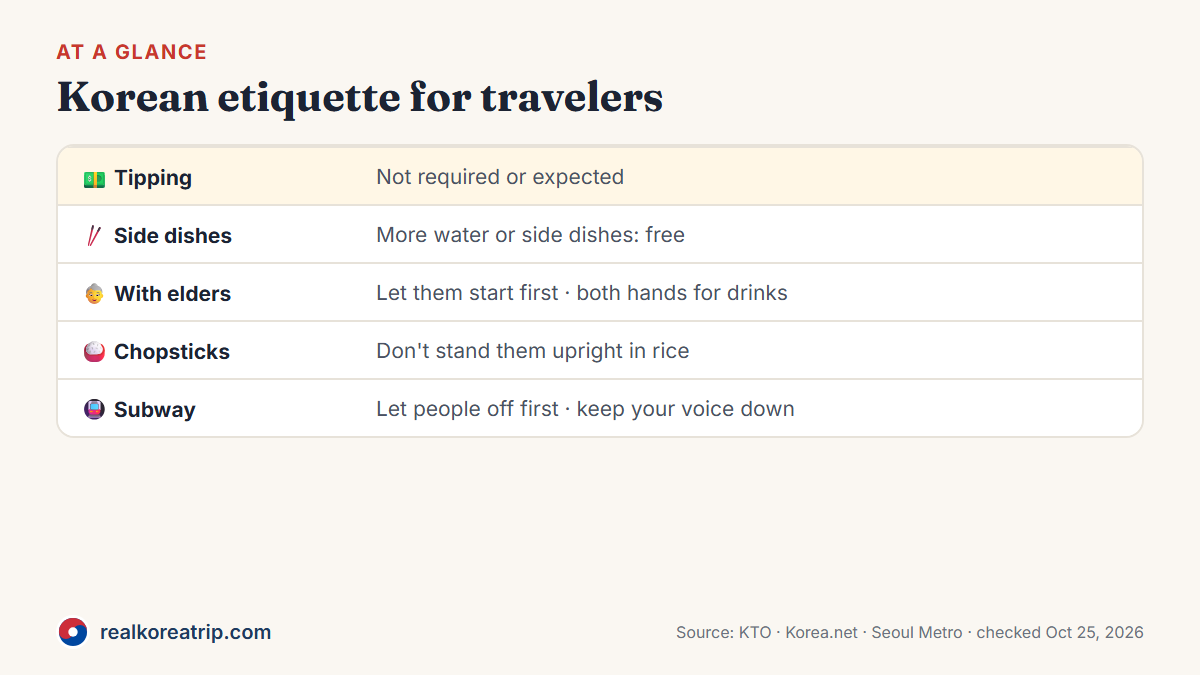
- Tipping is generally not expected. The Korea Tourism Organization says tipping isn't required or expected in Korea, and asking for more water or the complimentary side dishes costs nothing extra.
- At the table, follow the oldest person. Korea.net's guide says younger people usually wait for elders to start eating, and use both hands when pouring or receiving a drink from someone older.
- On the subway, let people off first and keep your voice down. Seoul Metro also asks riders to offer seats to pregnant women, people with children and the physically disadvantaged.
Three basics for visitors to Korea: tipping is generally not expected (the Korea Tourism Organization says it isn't required or expected), follow the oldest person's lead at the table, and on the subway let people off first and keep your voice down. Korea.net's guide also says many households eat quite casually. If you're unsure, follow your host's lead. Below: restaurants, table manners and Seoul Metro's 10 subway rules, each from an official source.
Source: Korea Tourism Organization — About Korean Food, Korea.net — table manners and Seoul Metro — etiquette; checked Oct 25, 2026.
The short version
| Where | Do | Don't |
|---|---|---|
| Restaurants | If there's a call bell, press it for service; ask for more water or complimentary side dishes (free) | Expect to tip: it isn't required or expected |
| At the table | Let older people start eating first; use both hands when pouring or receiving a drink from someone older | Stick chopsticks upright in rice; lift your rice or soup bowl; blow your nose at the table |
| Subway | Let passengers off before you board; keep to the right in stations; offer your seat to those who need it | Push on crowded trains; speak loudly |
Source: Korea Tourism Organization, Korea.net and Seoul Metro; checked Oct 25, 2026.
At a restaurant
| What the Korea Tourism Organization says | |
|---|---|
| Tipping | "Tipping is not required or expected in Korea." |
| Refills | More water or the complimentary side dishes don't cost extra; check the menu for anything ordered separately |
| Self-service | More restaurants let you serve your own water and side dishes, or order at a kiosk |
| Call bell | If provided, press the table's call button when you need a server (its guide notes it can be loud) |
| Cutlery | Its guide says tables have a small drawer with spoons, chopsticks and napkins |
| Storage chairs | Some chairs open up to store your coat and bag away from food smells |
Source: Korea Tourism Organization — About Korean Food (page updated Mar 24, 2023); checked Oct 25, 2026. What to order: what to eat in Jeonju and Busan.
Table manners
Korea.net, the government's official English site, runs a guide to table manners for visitors. Its main points:
| Situation | The custom |
|---|---|
| Setting the table | Rice on the left and soup on the right; the spoon on the left and chopsticks on the right |
| Eating with elders | Younger people usually wait until the older people at the table pick up their spoons and start |
| Drinks with elders | Hold the cup or bottle with both hands when pouring for or receiving from someone older, and turn slightly away when you drink |
| Chopsticks | Don't stick them upright in a bowl of rice: that is done in rituals for the dead |
| Bowls | Don't lift your rice or soup bowl while eating |
| Manners | Don't pick your teeth or blow your nose during a meal |
The same guide notes that not talking during meals was the etiquette in the past, and that many households now eat quite casually.
Source: Korea.net — While in Korea, Episode 7: Table manners (culture series, Sep 12, 2019); checked Oct 25, 2026.
On the subway
Seoul Metro lists 10 basic rules for riders:
- Don't push and shove on a crowded train.
- Let passengers get off the train before you board.
- Offer your seat to pregnant women, people with children and the physically disadvantaged.
- Don't walk or run on an escalator.
- Put your phone on vibrate and keep your voice down on calls.
- Don't buy things from peddlers on trains.
- Don't run or speak loudly on trains.
- Fold your newspaper for others, or take it with you when you get off.
- Keep to the right when walking in stations.
- Don't try to ride without paying.
Source: Seoul Metro — Subway etiquette; checked Oct 25, 2026. Fares and transfers: Seoul subway guide.
Before you go
- Tipping is generally not expected, so there's no need to budget for it.
- At a meal with older people, let them start first, and use both hands for drinks.
- Don't leave chopsticks standing in your rice.
- On the subway, let people off first, keep your voice down and keep to the right in stations.
- Need help explaining something? The 1330 Korea Travel Helpline interprets daily from 07:00 to midnight Korea time.
Source: Korea Tourism Organization, Korea.net, Seoul Metro and our emergency help guide; checked Oct 25, 2026. Bathhouse manners: our jjimjilbang guide.
FAQ
Do you tip in Korea?
No. The Korea Tourism Organization says tipping is not required or expected, and extra water or side dishes don't cost more.
What should I not do with chopsticks in Korea?
Don't stick them upright in a bowl of rice. Korea.net's guide explains that this is done in rituals for the dead.
How do I drink with older people in Korea?
Hold the cup or bottle with both hands when pouring for or receiving from someone older, and turn slightly away when you drink.
What are the rules on the Seoul subway?
Seoul Metro asks riders to let passengers off first, offer seats to pregnant women, people with children and the physically disadvantaged, keep their voice down and keep to the right in stations.
- Korea Tourism Organization — About Korean Food (visiting a restaurant)
- Korea.net — While in Korea, Episode 7: Table manners
- Seoul Metro — Subway etiquette
Last checked Oct 25, 2026. Details can change — please confirm with the official source before you travel.
We publish new guides regularly and update old ones when fares, rules or hours change. Follow our free RSS feed in any feed reader (such as Feedly or Inoreader), or check the latest guides on our homepage.