Bukchon Hanok Village Visiting Hours and Rules: The 10:00–17:00 Red Zone and ₩100,000 Fine
Quick answer
- On Bukchon-ro 11-gil (the red zone), sightseeing is allowed only from 10:00 to 17:00. From 17:00 to 10:00 the next morning, sightseeing visits aren't allowed.
- A violation can lead to a standard ₩100,000 fine, enforced since March 1, 2025. The rule targets sightseeing: residents, shop customers and overnight guests can still come and go, but not to sightsee or take tourist photos in restricted hours.
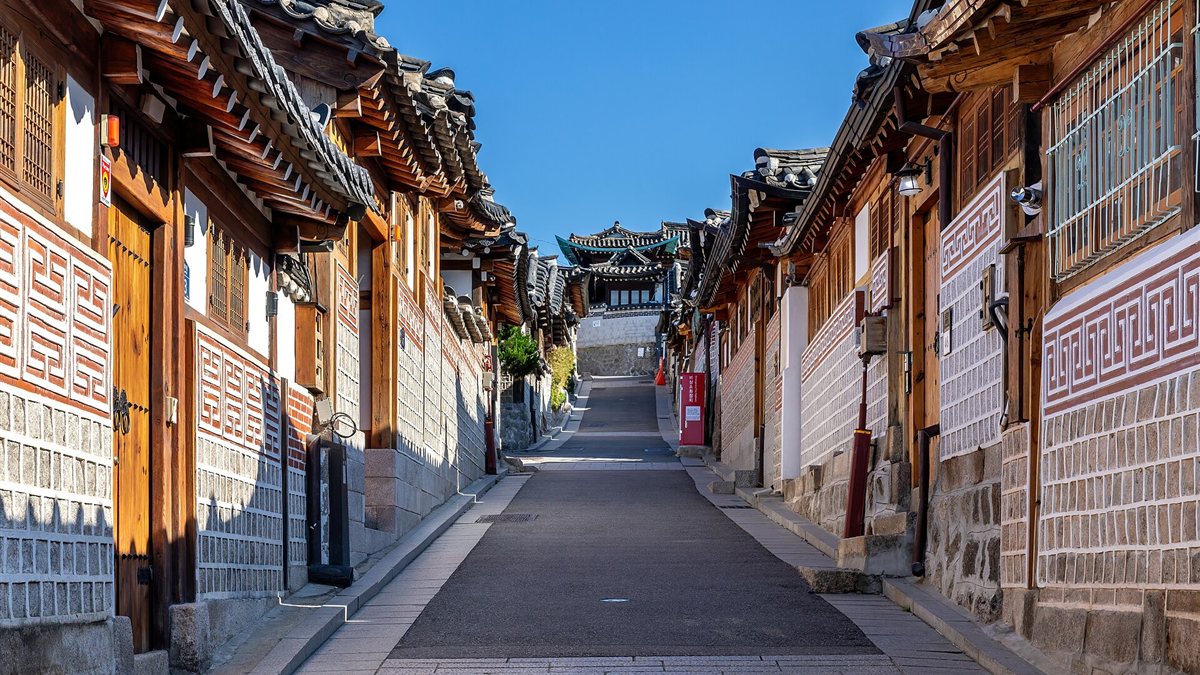
- Bukchon is a residential area: people live in these hanok. Keep your voice down, stay off doorsteps and stairs, and plan to finish the red zone before 17:00.
In Bukchon Hanok Village's red zone, Bukchon-ro 11-gil, sightseeing is allowed only between 10:00 and 17:00; outside those hours a violation can lead to a standard ₩100,000 fine, enforced since March 1, 2025. The rule protects the people who live in these hanok houses. There is no general entry fee; follow the current zone map and visiting guidance.
Below: where the rule applies, the other zones, chartered bus limits, how to visit politely and how to fit Bukchon into a day.
Source: Seoul Metropolitan Government and Korea Tourism Organization; checked Oct 27, 2026.
The short version
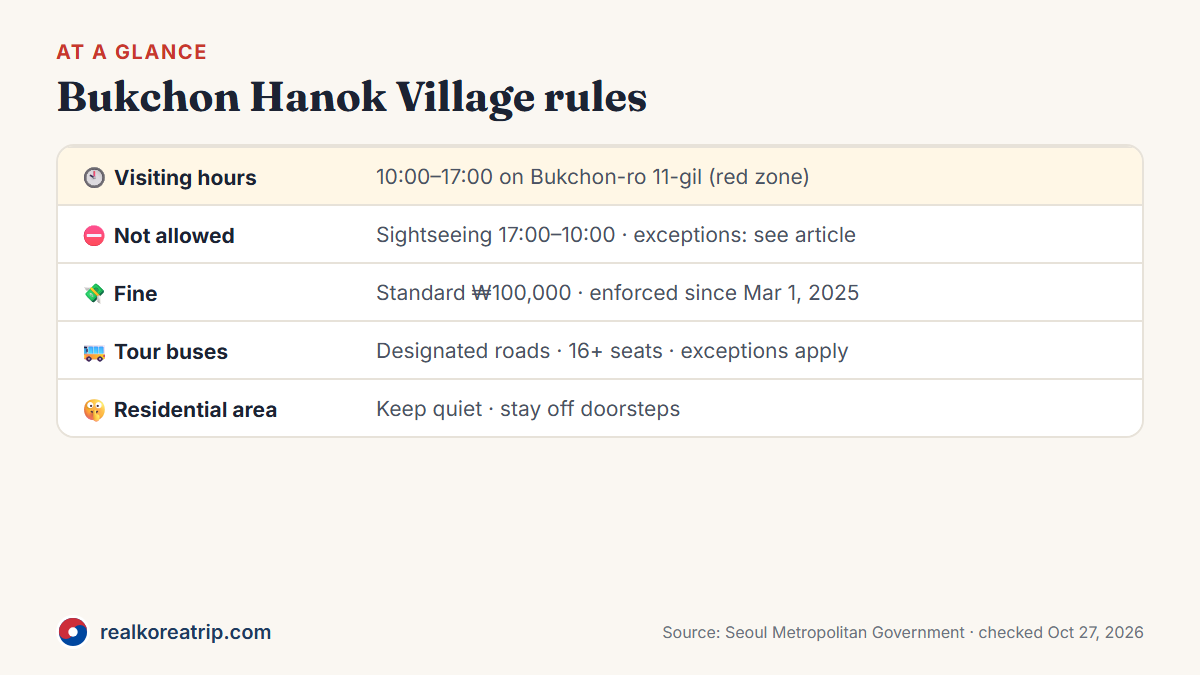
| Bukchon red zone (Bukchon-ro 11-gil) | |
|---|---|
| Tourist visiting hours | 10:00–17:00 |
| Not allowed | Sightseeing visits from 17:00 to 10:00 the next day |
| Exceptions | Residents, family or friends visiting them, shop customers, traders and people passing through, but not for sightseeing |
| Fine | Standard ₩100,000 |
| Enforced since | March 1, 2025 (guidance period Nov 1, 2024 – Feb 28, 2025) |
| Area | About 34,000 m² around Bukchon-ro 11-gil |
| Entry fee | Free |
| Questions | Visiting hours: Jongno-gu Office tourism team, +82-2-2148-1853 (Korean) · zone map and FAQ (Korean) |
Source: Jongno-gu Office (Korean, checked Oct 28, 2026), Seoul Metropolitan Government — notice and Korean notice; checked Oct 27, 2026.
Who the rule applies to
The restriction is on sightseeing, not every kind of access, Jongno-gu explains.
| What Jongno-gu says | |
|---|---|
| Covered | Visitors there for sightseeing: taking photos or videos, lingering to look around, or wandering the streets without using a shop |
| Exceptions | Residents, family or friends visiting them, shop customers, traders and people passing through |
| Overnight guests | May be asked to show a lodging reservation |
| Shop customers | Explain your shop visit or show a receipt |
| Even if exempt | Sightseeing or taking tourist photos in restricted hours can still be fined |
| Foreign visitors | The same rules apply |
| How it's enforced | On-the-spot checks by Bukchon enforcement officers, with a warning first; you get a chance to respond before a fine is finalized |
Source: Jongno-gu Office — Bukchon special management area FAQ (Korean); checked Oct 28, 2026.
The four zones
Bukchon is managed in zones under Korea's Tourism Promotion Act, to protect local residents' housing rights, the city says.
| Zone | What it means | In force |
|---|---|---|
| Red zone | Tourist visiting hours (fines) | Enforced since March 1, 2025 |
| Chartered bus zone | No chartered buses with 16 or more seats on designated roads at any time, including weekends and holidays (fines; approved exceptions) | Enforced since January 1, 2026 |
| Orange zone | Intensive guidance | In effect |
| Yellow zone | Intensive monitoring | In effect |
The bus restriction covers designated sections of Bukchon-ro, Bukchon-ro 5-gil, Bukchon-ro 4-gil and Changdeokgung 1-gil, about 2.3 km in total; it is a different area from the red zone. Jongno-gu targets chartered buses with 16 or more seats. Commuter, school and village buses and public-purpose vehicles can apply for an exception in advance, and other one-off cases can be explained after a notice; neither is automatic. Fines start at ₩300,000 (₩400,000 for a second violation, ₩500,000 for a third). If you're on a group tour, expect the bus to drop you outside the area; tour operators should check the official map and exception process (bus exception forms: Jongno-gu tourism team, +82-2-2148-1857, Korean).
Source: Jongno-gu Office (Korean, checked Oct 28, 2026; yellow zone FAQ checked Oct 30, 2026) and Seoul Metropolitan Government — notice (its English list omits Bukchon-ro 4-gil); checked Oct 27, 2026.
How to visit politely
The city's notice is blunt: "Bukchon is a residential area." In practice:
| Do | Don't |
|---|---|
| Sightsee in the red zone between 10:00 and 17:00 | Sightsee or take tourist photos in the red zone before 10:00 or after 17:00 |
| Keep your voice down in the alleys | Sit on doorsteps or climb residents' stairs for photos |
| Take photos from the street | Open gates or look into homes |
| Take your rubbish with you | Leave bags or tripods blocking doorways |
The Do and Don't rows apart from the visiting hours are our own suggestions for a residential street, not official rules.
Source: Seoul Metropolitan Government — notice; checked Oct 27, 2026.
Fitting Bukchon into a day
Bukchon sits between Gyeongbokgung and Changdeokgung, so it pairs well with either palace. Remember their closing days: Gyeongbokgung usually closes on Tuesdays, Changdeokgung on Mondays.
| Time | Plan |
|---|---|
| Morning | Gyeongbokgung or Changdeokgung and the Secret Garden |
| Midday to afternoon | Bukchon, finishing the red zone before 17:00 |
| Evening | Somewhere outside the red zone |
Source: Seoul Metropolitan Government (visiting hours) and our palace guides; checked Oct 27, 2026.
Before you go
- Plan your sightseeing on Bukchon-ro 11-gil between 10:00 and 17:00. Non-sightseeing access exceptions are explained above.
- Keep quiet and keep off doorsteps: people live here.
- Staying in the red zone? Carry your lodging reservation.
- On a group tour? Chartered buses (16+ seats) can't use the designated roads, so expect a walk.
- Need help in English? The 1330 Korea Travel Helpline runs daily from 07:00 to midnight Korea time.
Source: the notices above and our emergency help guide; checked Oct 27, 2026.
FAQ
What time can you visit Bukchon Hanok Village?
On Bukchon-ro 11-gil, the red zone, you can sightsee from 10:00 to 17:00. Sightseeing visits aren't allowed from 17:00 to 10:00 the next morning; residents, shop customers, overnight guests and people passing through can still come and go.
What is the fine in Bukchon Hanok Village?
The standard fine is ₩100,000 for sightseeing in the red zone during restricted hours, enforced since March 1, 2025. Officers give a warning first.
Can I go back to my guesthouse in Bukchon after 17:00?
Yes. Overnight guests are an exception and may be asked to show a lodging reservation, but sightseeing or taking tourist photos in restricted hours can still be fined.
Is Bukchon Hanok Village free?
There's no general entry fee. It's a residential neighborhood: follow the current zone map and visiting hours.
Can tour buses go into Bukchon?
Not on the designated roads. Since January 1, 2026, chartered buses with 16 or more seats can't use about 2.3 km of Bukchon's main roads at any time, with fines from ₩300,000. Some vehicles can get an approved exception.
Why does Bukchon have visiting hours?
To protect residents. Seoul says the area is designated for special management under the Tourism Promotion Act to protect local residents' right to live there.
- Jongno-gu Office — Bukchon special management area (Korean, with map and FAQ)
- Seoul Metropolitan Government — Notice on restrictions for tourist visits to Bukchon
- Seoul Metropolitan Government — Bukchon visiting-hour notice (Korean)
- Korea Tourism Organization — Bukchon Hanok Village
Last checked Oct 27, 2026. Details can change — please confirm with the official source before you travel.
Photo credits
We publish new guides regularly and update old ones when fares, rules or hours change. Follow our free RSS feed in any feed reader (such as Feedly or Inoreader), or check the latest guides on our homepage.