Gyeongbokgung Palace Guide: Hours, Tickets, Free Hanbok Entry and the Guard Ceremony
Quick answer
- Gyeongbokgung normally closes on Tuesdays (if a Tuesday is a public or substitute holiday, it opens that day and closes on the first non-holiday afterward). Hours change by season: in Nov–Feb it's 09:00–17:00, with last entry at 16:00.
- Foreign adults (19–64) pay ₩3,000. Entry is free for foreign visitors aged 18 and under or 65 and over, and for anyone wearing hanbok (top and bottom), Korean or not.
- Arrive by 10:00 for the gate guard ceremony, held at 10:00 and 14:00 (about 20 minutes). Free English tours start at 11:00, 13:30 and 15:30.
Gyeongbokgung, Seoul's main royal palace, normally closes on Tuesdays (a holiday Tuesday moves the closure to the first non-holiday afterward), and foreign adults (19–64) pay ₩3,000; entry is free if you're 18 or under, 65 or over, or wearing hanbok. Hours run 09:00–17:00 in Nov–Feb, 09:00–18:00 in Mar–May and Sep–Oct, and 09:00–18:30 in Jun–Aug, with last entry an hour before closing. The gate guard ceremony is at 10:00 and 14:00.
Built in 1395 as the Joseon dynasty's official palace, it is the largest of Seoul's five palaces, according to the Korea Tourism Organization. Below: hours, tickets, the hanbok rule, tours, the ceremony and a short route.
Source: Royal Palaces and Tombs Center (Korean), Korea Heritage Service Foundation (Korean) and Korea Tourism Organization; checked Oct 26, 2026.
The short version
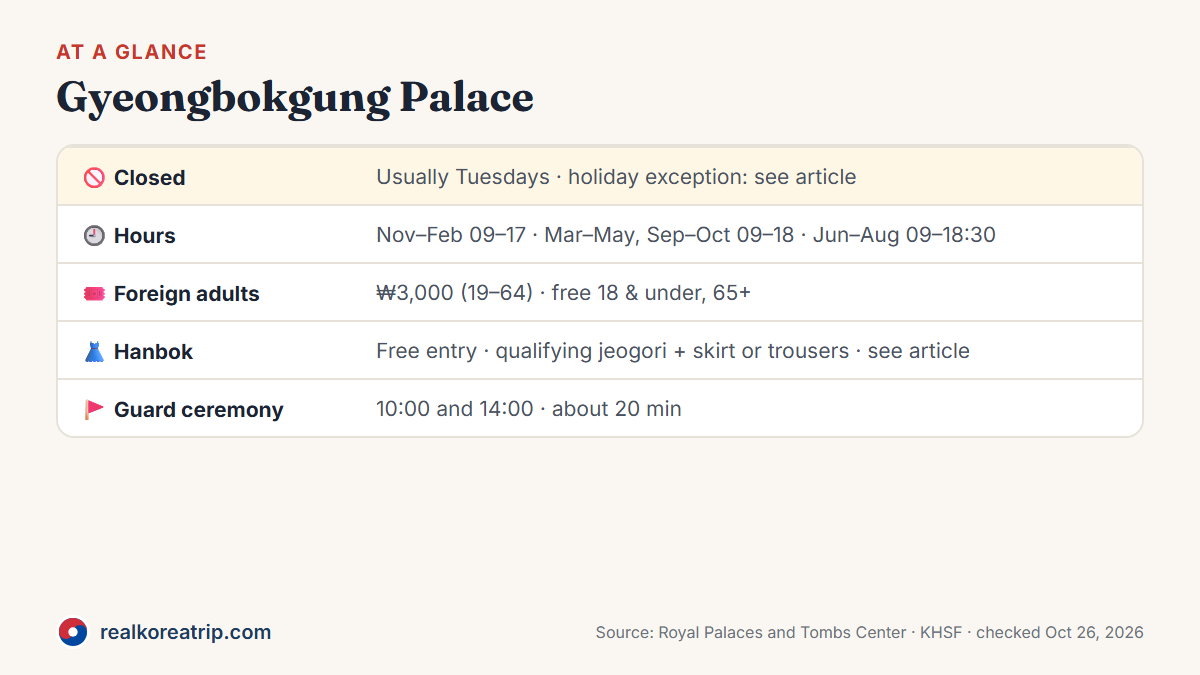
| Gyeongbokgung Palace | |
|---|---|
| Closed | Usually Tuesdays; if a Tuesday is a public or substitute holiday, it opens and closes on the first non-holiday afterward |
| Hours | Nov–Feb 09:00–17:00 · Mar–May, Sep–Oct 09:00–18:00 · Jun–Aug 09:00–18:30 |
| Last entry | 1 hour before closing (16:00, 17:00 or 17:30) |
| Ticket | Foreign adults 19–64: ₩3,000 (₩2,400 each in a group of 10 or more) |
| Free | Foreign visitors 18 and under or 65 and over; anyone in hanbok; bring proof of age |
| Guard ceremony | 10:00 and 14:00, about 20 minutes |
| English tour | Free, 11:00, 13:30 and 15:30 (not Tuesdays) |
| Getting there | Gyeongbokgung Station (Line 3), Exit 5: about a 2-minute walk |
Source: Royal Palaces and Tombs Center — hours, fees, tours and directions (Korean); checked Oct 26, 2026.
Hours and closing day
| Months | Open | Last entry |
|---|---|---|
| January–February, November–December | 09:00–17:00 | 16:00 |
| March–May, September–October | 09:00–18:00 | 17:00 |
| June–August | 09:00–18:30 | 17:30 |
The regular closing day is Tuesday. If a Tuesday falls on a public holiday or substitute holiday, the palace opens that day and closes on the first non-holiday after it.
Source: Royal Palaces and Tombs Center — hours (Korean); checked Oct 26, 2026.
Tickets and free entry
| Who | Price |
|---|---|
| Foreign adults, 19–64 | ₩3,000 |
| Groups of 10 or more (19–64) | ₩2,400 per person |
| Foreign visitors 18 and under, or 65 and over | Free (bring ID showing your age) |
| Anyone wearing hanbok | Free |
| Combined palace ticket | ₩6,000: one entry each to the four main palaces and Jongmyo Shrine within 6 months (not the Huwon garden at Changdeokgung) |
Two things to know:
- The free entry for those aged 24 or under that you may read about is for Korean nationals. For foreign visitors, the free age is 18 and under.
- Gyeongbokgung is not part of the free "Culture Day" on Wednesdays. The palace office lists Gyeongbokgung as an exception.
Source: Royal Palaces and Tombs Center — admission fees (Korean); checked Oct 26, 2026.
Free entry in hanbok: what counts
The palace office confirms that foreign visitors in hanbok get in free, the same as Koreans. Its guidelines:
| Counts as hanbok | Doesn't count |
|---|---|
| Traditional or modern hanbok with a jeogori (top) and a skirt or trousers | A jeogori over jeans, or hanbok bottoms with a T-shirt |
| A jeogori that wraps closed at the collar, with or without ties | A one-piece hanbok dress without a jeogori |
| A jeogori with a wrap skirt, if the top reaches the waist | A durumagi (long coat) on its own |
| Trousers in the traditional hanbok shape, even with a zipper waist and no ankle ties | A T-shirt-style top sold as modern hanbok |
The office also asks for hanbok that suits the dignity of the palace, with no excessive exposure.
Source: Royal Palaces and Tombs Center — free entry in hanbok guidelines (Korean); checked Nov 4, 2026.
What to see
| Place | What it is |
|---|---|
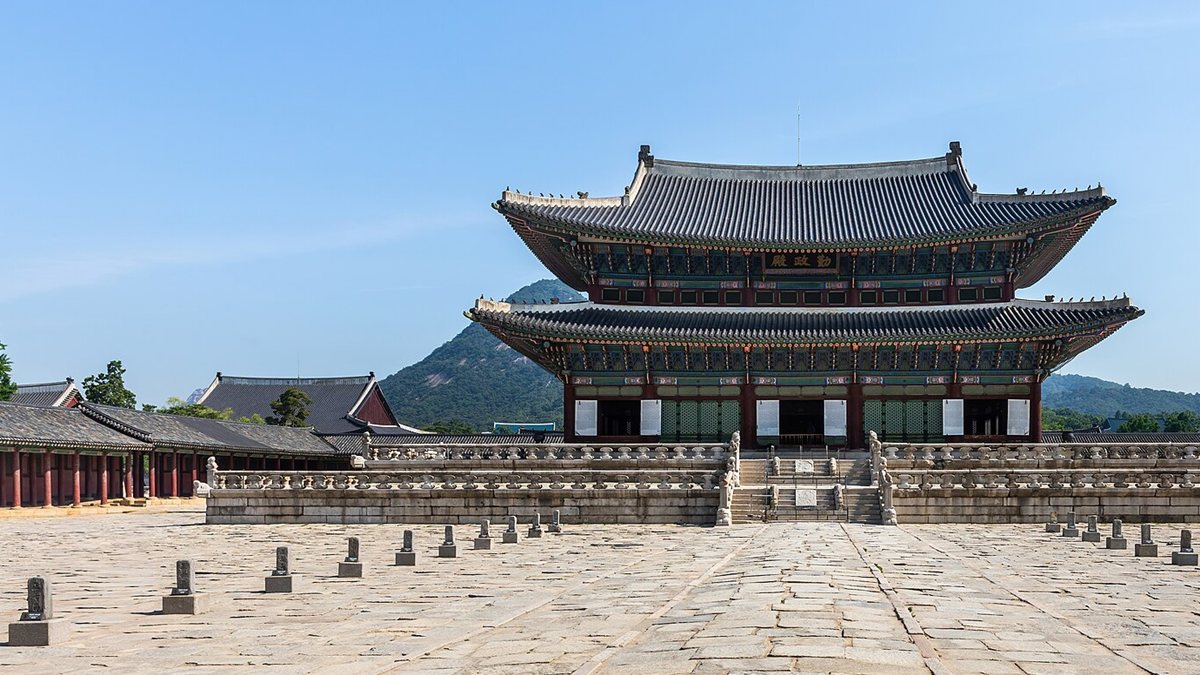
| Geunjeongjeon Hall | The throne hall; the Korea Tourism Organization notes its sculptures as examples of Joseon-era technique |
| Gyeonghoeru Pavilion | A royal banquet pavilion on a pond; the present building was rebuilt in 1867 |
| Hyangwonjeong Pavilion | A pavilion and pond inside the palace grounds |
| National Palace Museum of Korea | On the west side of the area outside Heungnyemun Gate |
| National Folk Museum of Korea | East of Hyangwonjeong Pavilion |
Source: Korea Tourism Organization — Gyeongbokgung Palace; checked Oct 26, 2026.
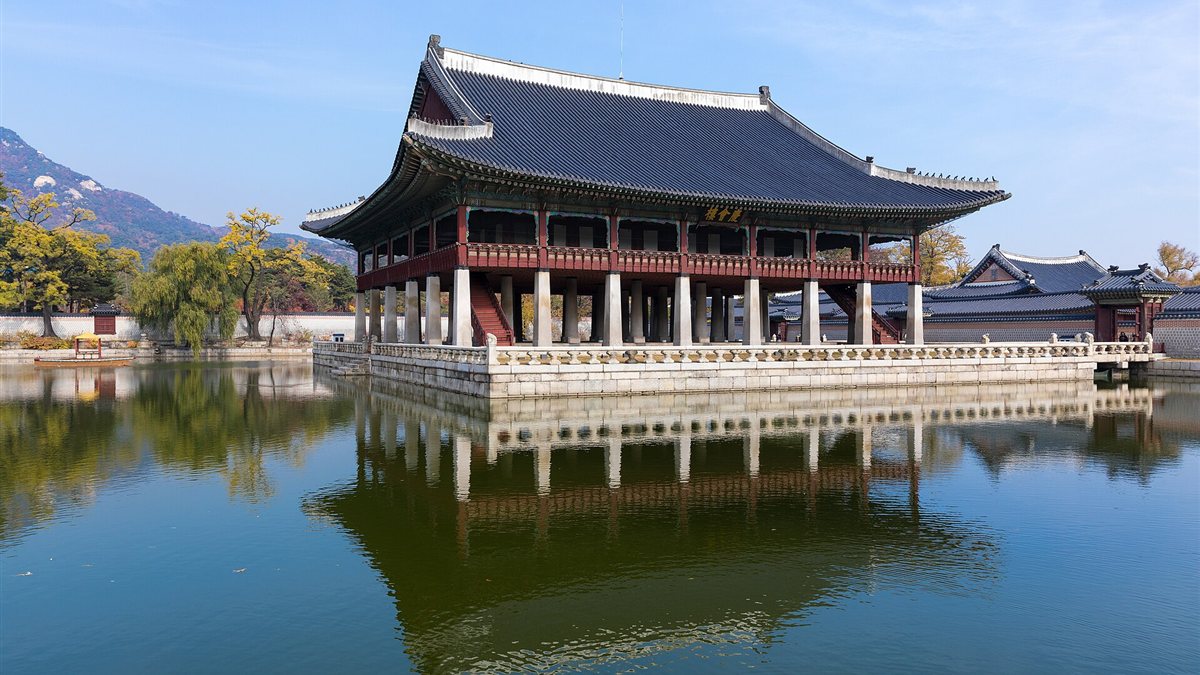
The palace burned during the Imjin War (1592–1598), and its buildings were later restored under King Gojong, the Korea Tourism Organization says. Separate interior visits to Gyeonghoeru and Hyangwonjeong are seasonal and need advance online booking. The program is in Korean only and is for ages 7 and over; children aged 6 or under can't enter or accompany a visitor, and the palace says visitors who can't follow the Korean commentary can't enter Gyeonghoeru. Check eligibility and dates on the palace's tour page and reservation page (Korean).
Source: Korea Heritage Service — Gyeonghoeru (Korean; period: 1867, 4th year of King Gojong) and the palace tour page above; checked Oct 26, 2026.
The gate guard ceremony
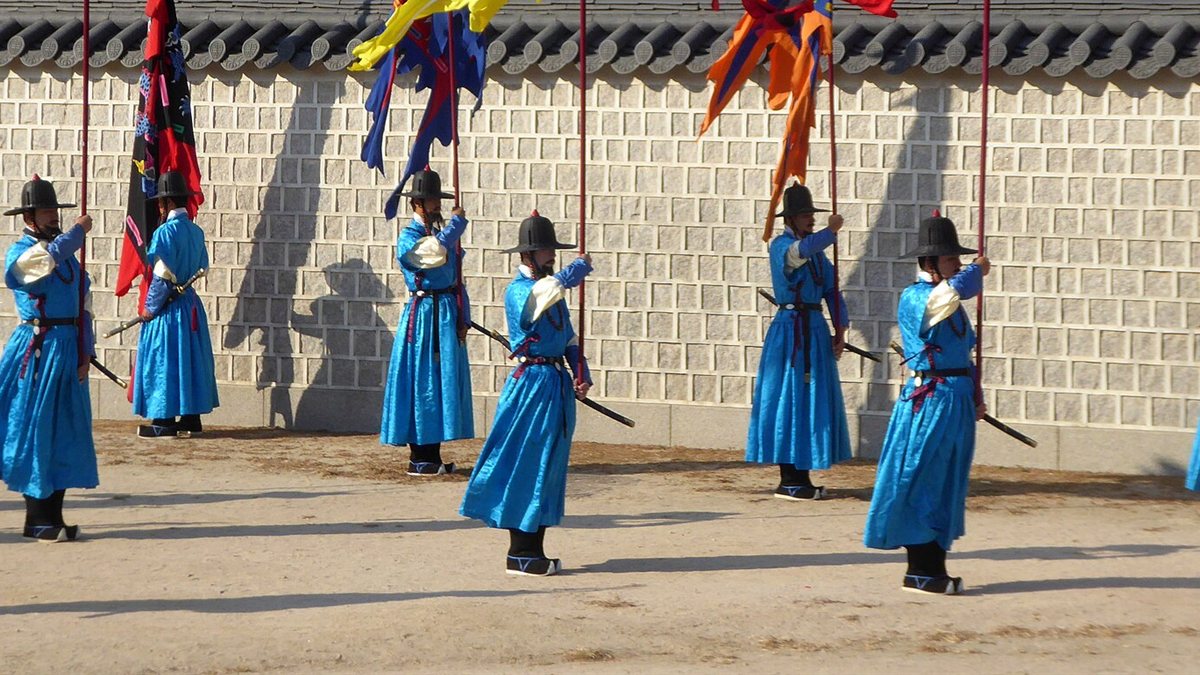
| Event | Time | Length |
|---|---|---|
| Royal Guard Changing Ceremony | 10:00 and 14:00 | About 20 minutes |
| Gwanghwamun gate watch ceremony | 11:00 and 13:00 | About 10 minutes |
| Open guard training | 09:35 and 13:35 | About 15 minutes |
It takes place around Gwanghwamun Gate and the square in front of Heungnyemun Gate. The ceremony has run since 2002, based on records from 1469. The organizers ask you not to touch the guards' flags and weapons or talk to the guards when taking photos, and not to walk between the guards during the ceremony.
Source: Korea Heritage Service Foundation — program and visitor notes (Korean); checked Oct 26, 2026.
Free guided tours
| Language | Start times |
|---|---|
| English | 11:00, 13:30, 15:30 |
| Japanese | 10:00, 14:30 |
| Chinese | 10:30, 15:00 |
The palace office lists English tours every day except Tuesday, when the palace is closed. Tours start in front of the information center inside Heungnyemun Gate. The palace lists the usual duration as 1–1.5 hours. Visitors in groups of fewer than 10 can join without booking; groups of 10 or more foreign visitors book by phone from a week to a day ahead. Tours leave on time, and you can't join after the start. From Oct 29 to Nov 15, 2026, the palace has announced changes to regular guided tours. Check the English tour schedule and duration with the palace office (+82-2-3700-3900). Tour times and routes can change.
Source: Royal Palaces and Tombs Center — guided tours (Korean); checked Oct 26, 2026.
A short route
The palace office suggests 40-, 60- and 90-minute routes. Its 40-minute route:
- Heungnyemun Gate
- Yeongjegyo Bridge
- Geunjeongjeon Hall
- Sajeongjeon Hall
- Sujeongjeon Hall
- Gyeonghoeru Pavilion
The 90-minute route adds Gangnyeongjeon, Gyotaejeon and Jagyeongjeon halls and ends at Hyangwonjeong Pavilion.
Source: Royal Palaces and Tombs Center — routes (Korean); checked Oct 26, 2026. Getting around Seoul: subway guide.
Before you go
- Check the closing day: usually Tuesday, with the public-holiday exception explained above.
- Check the season's last entry time: 16:00 in Nov–Feb.
- Bring ID if you're 18 or under or 65 or over, for free entry.
- In hanbok? Wear a jeogori with a skirt or trousers to get in free.
- Arrive by 10:00 or 14:00 for the guard ceremony.
- Need help in English? The 1330 Korea Travel Helpline runs daily from 07:00 to midnight Korea time.
Source: the palace pages above and our emergency help guide; checked Oct 26, 2026.
FAQ
What day is Gyeongbokgung closed?
Usually Tuesday. If a Tuesday is a public or substitute holiday, the palace opens that day and closes on the first non-holiday afterward.
How much is the Gyeongbokgung ticket for foreigners?
₩3,000 for foreign adults aged 19 to 64. It's free for foreign visitors 18 and under or 65 and over, and for anyone wearing hanbok.
Can foreigners get in free wearing hanbok?
Yes. The palace office says visitors in hanbok enter free whether they are Korean or not, as long as they wear a jeogori top with a skirt or trousers.
What time is the changing of the guard at Gyeongbokgung?
At 10:00 and 14:00, for about 20 minutes. A shorter gate watch ceremony runs at 11:00 and 13:00.
Is there an English tour of Gyeongbokgung?
Yes, free tours start at 11:00, 13:30 and 15:30 in front of the information center inside Heungnyemun Gate, every day except Tuesday. Times can change.
- Royal Palaces and Tombs Center — Gyeongbokgung hours (Korean)
- Royal Palaces and Tombs Center — Admission fees (Korean)
- Royal Palaces and Tombs Center — Free entry in hanbok guidelines (Korean)
- Royal Palaces and Tombs Center — Guided tours (Korean)
- Royal Palaces and Tombs Center — Notice, Oct–Nov 2026 opening (Korean)
- Korea Heritage Service Foundation — Royal Guard Changing Ceremony (Korean)
- Korea Tourism Organization — Gyeongbokgung Palace
Last checked Oct 26, 2026. Details can change — please confirm with the official source before you travel.
Photo credits
We publish new guides regularly and update old ones when fares, rules or hours change. Follow our free RSS feed in any feed reader (such as Feedly or Inoreader), or check the latest guides on our homepage.