What to Buy in Korea: Where to Shop, Daiso, and Getting It Home
Quick answer
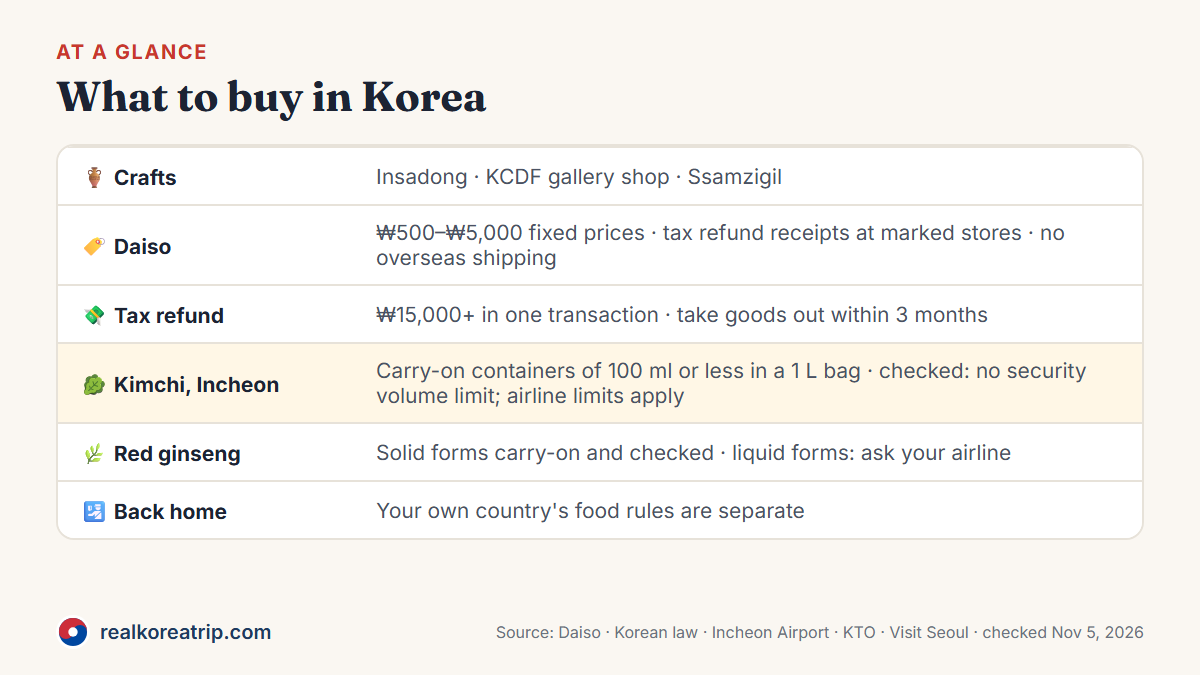
- Where: official sources point to Insadong and the Korea Craft & Design Foundation's gallery shop for crafts, and the National Museum shops for museum goods. We don't rank products.
- Daiso: it sets six fixed prices from ₩500 to ₩5,000. Its store finder marks which stores issue tax refund receipts to foreigners. It doesn't ship overseas.
- Flying home: at Incheon, kimchi in carry-on must be in containers of 100 ml or less inside a 1 L zip bag. Checked bags have no volume limit under that rule. Your own country's food rules are separate.
We don't rank souvenirs. This guide focuses on officially listed shopping locations, Daiso's price policy of six prices from ₩500 to ₩5,000, and the rules for taking purchases home. Kimchi is the classic trap: in carry-on at Incheon Airport, only containers of 100 ml or less inside a 1 L zip bag are allowed.
Source: Daiso and Incheon Airport (Korean); checked Nov 5, 2026.
Where official sources send you
| What you want | Where | What the source says |
|---|---|---|
| Traditional crafts, art, souvenirs | Insadong, by Anguk or Jongno 3-ga Station | Visit Seoul lists antique shops, galleries, traditional paper and handicraft shops |
| Crafts in a foundation-run shop | KCDF Gallery shop, 1F, 8 Insadong 11-gil | KTO lists 10:00–19:00, open all year. Check before you go, because KCDF's own page gives no hours |
| Crafts in a mall | Ssamzigil, 44 Insadong-gil | KTO lists 10:30–20:30, open all year |
| Museum goods | National Museum of Korea shops | See below |
| Everyday food and souvenirs | Large supermarkets and traditional markets | KTO's shopping page lists both |
| Skincare | See our K-beauty guide | Tax refund, labels and flight rules are all there |
National Museum shops. The main shop is beside the Great Hall on the 1st floor of the West Wing, open 9:30–17:30, and until 21:00 on Wednesdays and Saturdays. It closes on Jan 1, on Seollal and Chuseok days, and on the first Monday of March, June, September and December. A second shop in the permanent exhibition hall has different closing months, so check the page.
Antiques need care. Insadong has antique shops, and Incheon Airport says cultural property needs an export permit or a certificate that it isn't cultural property. We didn't find which items that covers. Ask the seller and check with the authorities before you buy anything old.
Source: Visit Seoul — Insa-dong, KCDF, KTO on KCDF, Ssamzigil and where to shop, National Museum and Incheon Airport (Korean); checked Nov 5, 2026.
Daiso: the facts
Daiso is a Korean fixed-price chain. These details are on Daiso's Korean pages.
| Question | What Daiso says |
|---|---|
| Prices | Six fixed price points: ₩500, ₩1,000, ₩1,500, ₩2,000, ₩3,000 and ₩5,000 |
| Tax refund | The store finder marks stores with "택스리펀드". Its legend says that means tax refund receipts, for foreigners only |
| Which stores | It varies by store. On the day we checked, several Myeongdong, Seoul Station and Jongno stores had the mark and one Seoul Station-area store didn't |
| SIM cards | Some stores are marked as selling them |
| Overseas shipping | Not offered |
The ₩15,000 refund minimum matters here. Since the top price is ₩5,000, you'd need several items in one payment to reach it (our arithmetic). Daiso's page says "receipts", not an instant refund, so ask staff how it works at that store.
We couldn't find an official answer on whether foreign-issued cards work at Daiso, or whether visitors can join its online store. Some stores are marked cashless, so carry a card as well as cash. See paying in Korea. We also found no official guidance on Daiso's cosmetics for visitors, and we don't recommend products.
Source: Daiso — Promise, Store finder and FAQ (Korean); checked Nov 5, 2026.
Tax refunds in brief
By Korean law, the minimum is ₩15,000 in one transaction, tax included, and you need to take the goods out of Korea within 3 months. An instant refund at the shop applies to transactions under ₩1,000,000, up to ₩5,000,000 in total after arrival. Tobacco is excluded, along with items such as designated cultural heritage.
KTO lists clothing, shoes, bags, cosmetics, perfume, ginseng and red ginseng among eligible goods, and says cooked food and massage services aren't. We found no official statement on packaged snacks, so ask at the till. Our tax refund guide has the full steps.
Source: Special rules on refunds and enforcement rules (Korean), KTO; checked Nov 5, 2026.
Getting food and ginseng on the plane
These are Incheon Airport's rules for international flights. We didn't read the guidance for other Korean airports, so check yours.
| Item | Carry-on | Checked |
|---|---|---|
| Kimchi, gochujang and other liquid or gel foods | Containers of 100 ml or less, in one 1 L zip bag per person | Allowed, no volume limit |
| Red ginseng, herbal medicine and supplements in solid form, including pills and powders | Allowed; quantity limits may vary by airline | Allowed; quantity limits may vary by airline |
| Solid side dishes such as dried squid or dried anchovies | Allowed | Not covered by the FAQ we read |
| Liquids bought at duty-free | Any volume in the sealed duty-free bag, unopened until your final flight | Not covered by this rule |
"No volume limit" is the security rule. Your airline's weight limits still apply, and leaks are your problem. Pack kimchi with that in mind.
Liquid red ginseng isn't mentioned in the FAQ, which covers solid forms only. Treat pouches and extracts as liquids and ask your airline. That's our suggestion, not an official rule. Fresh ginseng: Incheon lists plants and farm produce as restricted items that need an inspection certificate, and we couldn't confirm how that applies to fresh roots. KTO gives a plant export inspection number: +82-32-740-2077.
Source: Incheon Airport — Restricted items (Korean) and FAQ, KTO — Quarantines; checked Nov 5, 2026.
Duty-free shopping as a visitor
Foreign visitors can use airport and downtown duty-free shops. Bring your passport and flight details, and make sure the name and number match, because a mismatch can stop you collecting your goods.
Downtown purchases are generally collected at the airport pickup desk on your departure day, with your passport, boarding pass and voucher. There's one exception: foreigners buying Korean-made goods at a downtown duty-free shop can get them on the spot after a passport and boarding pass check.
Spending limits. You'll see US$800 quoted online, but that's the allowance for travelers arriving in Korea, not a limit on what you buy when leaving. The purchase cap that was abolished in 2022 was the one for Korean citizens. We found no official page stating a cap for departing foreigners, so we won't claim there is or isn't one.
Your purchases still have to clear customs in your destination country.
Source: Easy Law — Buying and Collecting (Korean) and Korea Policy Briefing (Korean); checked Nov 5, 2026.
Your own country decides what gets in
Clearing Korean security doesn't mean your country will let the food in. We didn't find official lines on kimchi or ginseng for specific countries, so check your own agency. Two examples show how different the rules can be:
- United States: USDA APHIS says travelers must declare all agricultural and wildlife products. It says that if you declare them, you won't face penalties, even if an inspector decides they can't enter.
- Japan: the Animal Quarantine Service says most meat and animal products can't be brought in. It says illegal importation can lead to a fine of up to ¥3 million or up to 3 years in prison.
Source: USDA APHIS and Japan Animal Quarantine Service (Japanese); checked Nov 5, 2026.
Before you go
- Look up your own country's food rules before buying kimchi, ginseng or meat snacks.
- Put liquid and gel foods in checked bags, or in 100 ml containers in a 1 L zip bag.
- Keep receipts and original packaging for food.
- Spending ₩15,000 or more? Pay in one transaction and ask about tax refund first.
- Check Daiso's store finder for the "택스리펀드" mark.
- Buying downtown duty-free? Have your passport and flight details ready, and allow time for the airport pickup desk.
- Ask about export paperwork before buying antiques.
Source: Incheon Airport and refund rules (Korean); checked Nov 5, 2026.
FAQ
What should I buy in Korea?
We don't rank souvenirs. Official tourism pages point to Insadong and the KCDF gallery shop for crafts, and the National Museum shops for museum goods. For skincare, see our K-beauty guide.
Can I get a tax refund at Daiso?
It depends on the store. Daiso's store finder marks stores that issue tax refund receipts to foreigners. You'd still need ₩15,000 or more in one transaction, and with a top price of ₩5,000 that means several items.
Can I bring kimchi on a plane from Korea?
At Incheon, yes, in carry-on only in containers of 100 ml or less inside a 1 L zip bag, and in checked bags with no volume limit under the security rule. Your airline and destination country have their own rules.
Can I take red ginseng on the plane?
Incheon Airport says solid forms, including pills and powders, can go in carry-on and checked bags, though quantities may vary by airline. It doesn't address liquid forms in that FAQ, so ask your airline.
Is there a limit on duty-free shopping for foreigners in Korea?
We found no official page stating one. The abolished cap applied to Koreans, and US$800 is an arrival allowance for Korea, not a limit on what you buy when leaving. Your destination's customs rules still apply.
- Korea Craft & Design Foundation — KCDF Gallery
- Korea Tourism Organization — KCDF Gallery Shop
- Korea Tourism Organization — Ssamzigil
- Korea Tourism Organization — Where to Shop (last updated Oct 20, 2025)
- Korea Tourism Organization — Tax refund guide (Oct 20, 2025)
- Korea Tourism Organization — Animal/Plant Quarantines (Sept 28, 2026)
- Visit Seoul — Insa-dong (edited May 4, 2026)
- National Museum of Korea — Facilities (Korean)
- Daiso — Our promise, prices (Korean)
- Daiso — Store finder (Korean)
- Daiso — FAQ (Korean)
- Korean law — Special rules on refunds for foreign tourists (in force Jan 2, 2026, Korean)
- Korean law — Enforcement rules for those refunds (in force Jan 2, 2026, Korean)
- Incheon Airport — Restricted items (Korean)
- Incheon Airport — FAQ
- Easy Law — Buying duty-free goods (Oct 15, 2026, Korean)
- Easy Law — Collecting duty-free goods (Oct 15, 2026, Korean)
- Korea Policy Briefing — Duty-free limit for Koreans abolished (Feb 9, 2022, Korean)
- USDA APHIS — Traveling from another country (Mar 31, 2026)
- Japan Animal Quarantine Service — Meat products (Japanese)
Last checked Nov 5, 2026. Details can change — please confirm with the official source before you travel.
We publish new guides regularly and update old ones when fares, rules or hours change. Follow our free RSS feed in any feed reader (such as Feedly or Inoreader), or check the latest guides on our homepage.